
Can Police Certificates or DBS Checks Be Apostilled?
Introduction
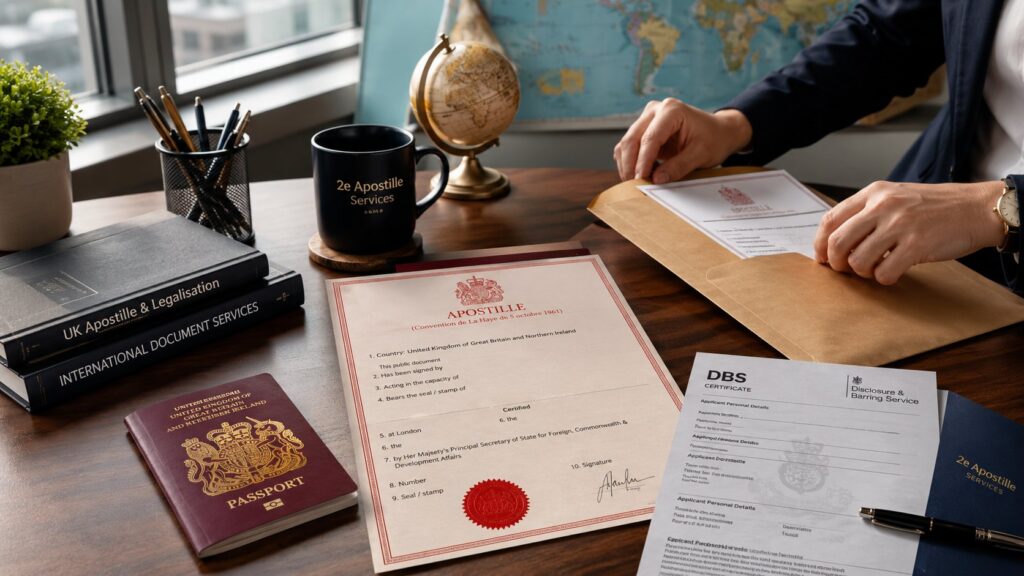
When moving abroad for work, study, immigration, residency or professional registration, you may be asked to provide evidence of your criminal record history. For people who have lived or worked in the UK, this can mean providing a police certificate or Disclosure and Barring Service (DBS) certificate to an overseas authority.
One question that often causes confusion is: Can DBS checks be apostilled, and can police certificates be legalised for use overseas?
The answer is yes, certain UK police certificates and DBS certificates can be legalised with a paper-based apostille, but there are important rules about which documents are eligible and which type of apostille can be used. In particular, the UK Legalisation Office confirms that ACRO police certificates for England and Wales and DBS certificates for England and Wales cannot currently receive an e-Apostille. They require a paper-based apostille instead.
In this guide, we explain what police certificates and DBS checks are, whether they can be apostilled, how the FCDO apostille process works, what documents you may need, common mistakes to avoid and what you should check before sending your documents overseas.
Watch this short video for a quick explanation of apostilling police certificates and DBS checks:
What Is an Apostille?
An apostille is an official certificate used to authenticate certain UK documents for use in countries that recognise the Hague Apostille Convention.
The purpose of an apostille is to confirm the authenticity of a signature, stamp or seal appearing on a document. The receiving country can then verify the document more easily.
An apostille does not:
- Translate a document.
- Confirm that every statement in the document is true.
- Automatically make a document acceptable for every purpose.
- Replace a translation if one is required.
- Guarantee that an overseas authority will accept a document for a particular application.
The person or organisation requesting the document should therefore be consulted before you start the legalisation process.
The FCDO specifically advises applicants to check with the person asking for the document to confirm whether it needs to be legalised.
What Is a Police Certificate?
A police certificate is a document showing information about an individual’s criminal record or confirming that relevant criminal record information is held or not held.
Police certificates are commonly requested when someone is:
- Applying for a visa.
- Moving permanently to another country.
- Applying for residency.
- Seeking employment overseas.
- Applying for professional registration.
- Obtaining citizenship.
- Completing an immigration or security process.
For UK applicants, the exact organisation that issues the relevant certificate can depend on where the person lived and which type of record check is required.
For example, ACRO police certificates are commonly used for international visa and immigration purposes.
What Is a DBS Certificate?
A DBS certificate is issued by the Disclosure and Barring Service for eligible roles and activities in England and Wales.
DBS checks come in different levels, including:
- Basic
- Standard
- Enhanced
- Enhanced with Barred List(s)
A Basic check shows unspent convictions and conditional cautions. Standard and Enhanced checks provide more information according to the eligibility and legal requirements for the role.
DBS checks are generally associated with employment, volunteering and regulated roles within the UK.
However, a DBS certificate may sometimes be requested by an overseas organisation.
This is where it becomes particularly important to establish whether the foreign authority specifically wants a DBS certificate, an ACRO police certificate, or another form of criminal record check.
Can DBS Certificates Be Apostilled?
Yes, but it requires a paper-based apostille
A DBS certificate can be legalised by the UK Legalisation Office using a paper-based apostille, provided it meets the relevant legalisation requirements.
However, the FCDO currently states that DBS certificates for England and Wales cannot receive an e-Apostille.
This means that if you have a DBS certificate that needs legalisation for overseas use, you should expect the apostille to be attached to the physical document rather than issued electronically.
This is an important distinction because the UK now offers two broad apostille options:
- Paper-based apostille
- Electronic e-Apostille
Not every document is eligible for both.
Can an ACRO Police Certificate Be Apostilled?
Yes, but not by e-Apostille
The FCDO specifically lists ACRO police certificates for England and Wales among the documents that cannot receive an e-Apostille.
This does not mean that the certificate cannot be legalised.
Instead, it means that the appropriate route is a paper-based apostille.
This distinction is particularly important for applicants who have been told that they need an apostilled police certificate for an overseas immigration or employment application.
Before sending the document, check that:
- It is the correct police certificate.
- It is acceptable to the receiving authority.
- It is suitable for FCDO legalisation.
- You understand whether a paper apostille is required.
- Any translation requirements have been confirmed.
When Might You Need an Apostilled Police Certificate?
An apostilled police certificate may be requested for several reasons.
Immigration
Some countries request police or criminal record certificates as part of visa and residency applications.
Overseas Employment
An employer may require evidence of your criminal record history before you begin working in another country.
This can be particularly relevant for jobs involving:
- Children
- Healthcare
- Education
- Security
- Government
- Financial services
- Regulated professions
Professional Registration
A professional regulator may request criminal record evidence when registering an overseas applicant.
Citizenship Applications
Some citizenship or naturalisation processes require police certificates from countries where the applicant previously lived.
Long-Term Residency
Permanent residency applications can sometimes require evidence of criminal record history.
The exact requirements vary between countries, so the overseas authority should always be treated as the final source for application-specific requirements.

DBS Certificate vs Police Certificate: Which One Do You Need?
This is one of the most important questions to answer before arranging an apostille service UK.
A DBS certificate and a police certificate are not automatically interchangeable.
A DBS check is primarily part of the UK disclosure and barring system. The level of DBS check available depends on the role and applicable eligibility rules.
An overseas immigration authority may instead specifically request a police certificate.
Therefore, if your instructions say:
“Provide a police certificate”
you should not automatically order a DBS certificate simply because it contains criminal record information.
Likewise, if the authority specifically requests a DBS certificate, replacing it with another document could cause problems.
Always check:
- The exact name of the required document.
- The issuing organisation.
- The required date or validity period.
- Whether an apostille is required.
- Whether translation is required.
- Whether embassy legalisation is required.
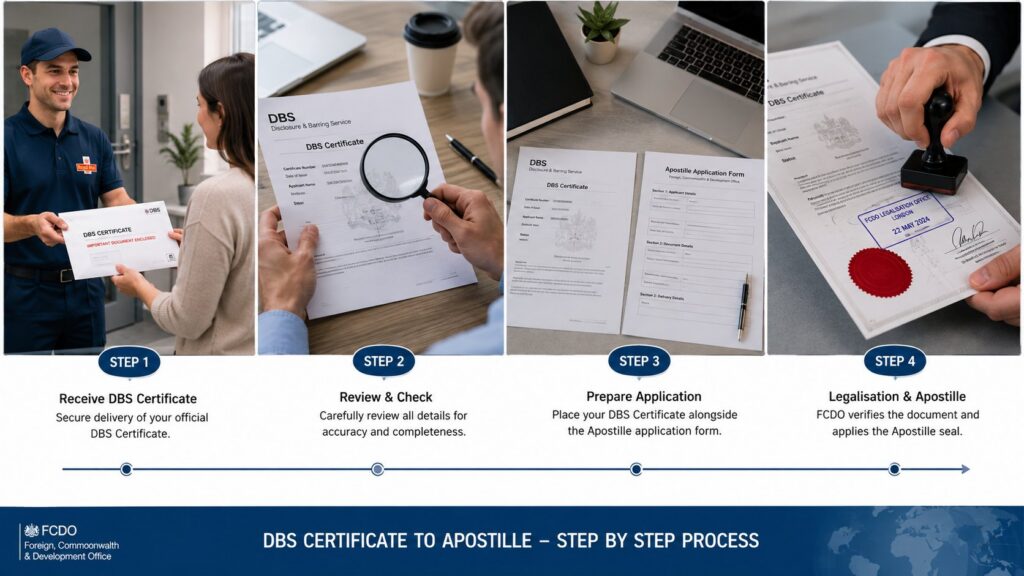
How to Get a Police Certificate or DBS Check Apostilled
The process generally involves several stages.
Step 1: Confirm Which Certificate You Need
Before arranging an apostille, establish whether the overseas authority wants:
- DBS certificate
- ACRO police certificate
- Another police certificate
- A specific criminal record document
Do not start legalisation until this is clear.
Step 2: Obtain the Certificate
You need to obtain the relevant certificate from the appropriate issuing organisation.
For DBS checks, the type of check depends on the role and eligibility.
A Basic DBS check can be requested by an individual, while Standard and Enhanced checks generally require an eligible organisation or other qualifying arrangement.
For police certificates, follow the issuing authority’s application process.
Step 3: Check the Certificate
Before sending the certificate for legalisation, check:
- Your full name.
- Date of birth.
- Certificate details.
- Dates.
- Spelling.
- Any other personal information.
Errors should ideally be corrected before legalisation.
This is especially important because an apostille does not correct errors in the underlying document.
Step 4: Check Whether Certification Is Required
Some documents may require additional certification before the FCDO can legalise them.
The FCDO explains that some UK documents need to be certified before they can be legalised.
Do not assume that every document follows exactly the same procedure.
Step 5: Apply for the Paper-Based Apostille
Because ACRO police certificates and DBS certificates are listed as ineligible for e-Apostille, the relevant route is a paper-based apostille.
The FCDO’s application process requires the documents you want to legalise and payment of the relevant fee. For postal applications, you also need the return address and access to a printer.
Can a DBS Certificate Receive an e-Apostille?
No.
This is a particularly important point.
The current GOV.UK guidance specifically states that DBS certificates for England and Wales cannot receive an e-Apostille. The same restriction applies to ACRO police certificates for England and Wales.
Therefore, if you are searching for an “e-Apostille DBS check”, you should be careful about services that imply that every UK document can be processed electronically.
How Long Does It Take to Apostille a DBS or Police Certificate?
Processing time can vary depending on the service selected and the document involved.
The overall timeframe can include:
- Obtaining the certificate.
- Checking the document.
- Certification, if required.
- FCDO legalisation.
- Postal or courier delivery.
- Translation, if required.
- Additional embassy legalisation, if applicable.
If you are working towards an overseas visa or employment deadline, allow enough time for all stages rather than considering only the apostille processing period.
The FCDO publishes different legalisation service options, including standard and urgent services. Current official fees and service options should be checked before applying because they can change.
Does a Police Certificate Need to Be Translated?
Possibly.
An apostille and translation are separate processes.
If your destination country operates in a language other than English, the receiving authority may request a certified translation of the police certificate and potentially the apostille.
Before arranging translation, ask the overseas authority:
- Is translation required?
- Does the certificate need to be translated?
- Does the apostille need to be translated?
- Does the translation need to be certified?
- Must the translator be officially recognised?
- Should translation take place before or after legalisation?
Do not assume that every country follows the same procedure.
Common Mistakes When Apostilling DBS and Police Certificates
1. Ordering the Wrong Document
This is one of the biggest mistakes.
A DBS certificate and police certificate are not necessarily interchangeable.
Always follow the exact wording of the overseas authority.
2. Applying for an e-Apostille
DBS and ACRO police certificates from England and Wales are specifically excluded from e-Apostille eligibility.
A paper apostille is required.
3. Ignoring the Certificate Date
Some organisations require a recent police certificate.
An apostille does not necessarily make an old certificate acceptable.
Check whether the receiving authority specifies a maximum age.
4. Assuming the Apostille Is the Final Step
Some destinations may require additional legalisation depending on their status under the Hague Convention and the requirements of the receiving authority.
The FCDO advises checking the requirements of the organisation requesting the document.
5. Forgetting Translation
If the receiving authority requires a certified translation, an apostille alone may not be enough.
6. Sending a Damaged Certificate
Keep the original document in good condition and avoid unnecessary alterations.
Can You Use a DBS Apostille in Every Country?
Not necessarily.
An apostille is designed for countries that participate in the Hague Apostille Convention, but the receiving authority still determines whether the document meets its application requirements.
For countries outside the Hague system, additional legalisation may be required.
The FCDO explains that where a destination country is not a member of the Hague Convention, a three-step legalisation process may apply: FCDO legalisation, embassy legalisation in London and approval by the Ministry of Foreign Affairs in the destination country.
Frequently Asked Questions
1. Can a DBS certificate be apostilled?
Yes. A DBS certificate can be legalised with a paper-based apostille if it meets the relevant requirements. However, DBS certificates for England and Wales are not eligible for an e-Apostille.
2. Can an ACRO police certificate be apostilled?
Yes. An ACRO police certificate can be legalised, but ACRO police certificates for England and Wales are not eligible for an e-Apostille and require a paper-based apostille.
3. Can I get an e-Apostille for a DBS check?
No. Current GOV.UK guidance specifically excludes DBS certificates for England and Wales from e-Apostille eligibility.
4. Does my police certificate need to be translated?
It depends on the requirements of the foreign authority. Some countries and organisations require a certified translation, while others may accept the English document.
5. Does an apostille make a DBS certificate valid forever?
No. An apostille authenticates the relevant signature, stamp or seal; it does not change the validity period or age requirements imposed by the receiving authority.

Conclusion
Police certificates and DBS checks can be important documents when you are moving, working or applying for residency overseas. However, the correct legalisation process depends on which certificate you have, where it was issued, where it will be used and what the receiving authority requires.
For England and Wales, the current FCDO guidance confirms that ACRO police certificates and DBS certificates are not eligible for e-Apostilles. If they need to be legalised, the appropriate route is a paper-based apostille.
It is also important to distinguish between a DBS certificate and a police certificate. They are different types of documents and should not automatically be treated as interchangeable.
If you are preparing apostille documents UK for an overseas employer, immigration authority, university or government department, getting the process right from the beginning can make international document preparation much easier.
For professional assistance with UK document legalisation, you can use 2eApostille’s Apostille Service UK to help prepare your documents for international use.