
Do Apostilles Need to Be Translated for Foreign Authorities?
Introduction
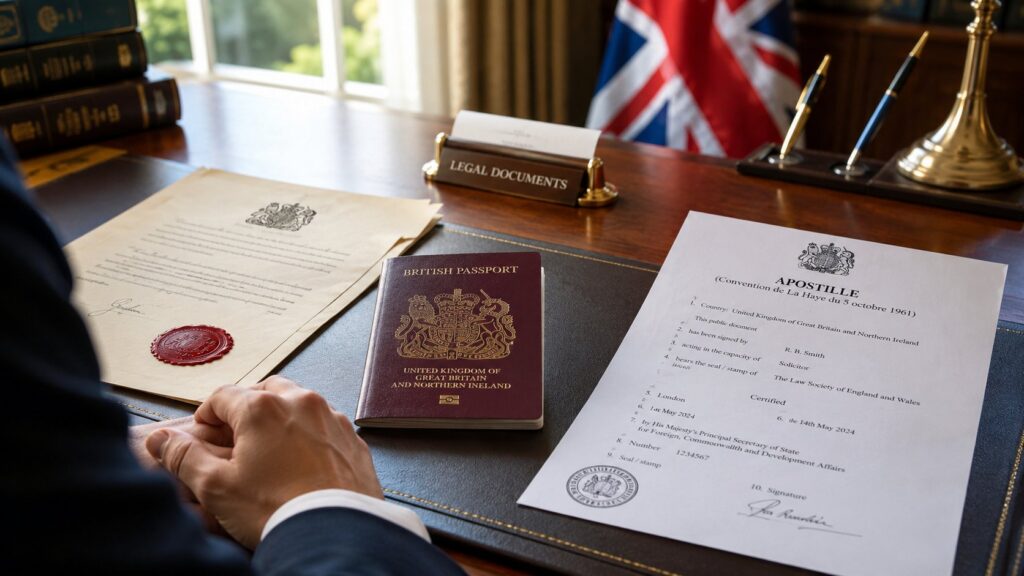
When preparing UK documents for use abroad, one of the most common questions is: Do apostilles need to be translated for foreign authorities? If you are dealing with immigration, overseas employment, education, marriage, residency, property, or business matters, you may already know that your UK document could require an apostille. However, you may be unsure whether the apostille itself also needs to be translated.
The answer is that there is no single rule for every country or situation. An apostille is issued in a standard international format under the Hague Apostille Convention, but the foreign authority receiving your documents may have its own language and translation requirements. In some cases, the original UK document needs a certified translation. In others, the authority may also ask for the apostille certificate to be translated.
The UK Legalisation Office currently offers both paper-based apostilles and e-Apostilles. For paper-based applications, legalised documents can be returned by post or courier, while e-Apostilles can be shared digitally. The current GOV.UK guidance also recommends checking whether the receiving party can verify and accept the type of apostille being provided.
If you need professional assistance with an apostille service UK, you can learn more about the service available from 2eApostille here:
You can also watch this short video for a simple explanation of the apostille process:
What Is an Apostille?
An apostille is an official certificate used to authenticate a public document for international use in countries that recognise the Hague Apostille Convention.
In the UK, apostilles are issued by the Foreign, Commonwealth & Development Office (FCDO) through its Legalisation Office. The apostille confirms the authenticity of a signature, seal, or stamp on the document. It does not confirm that every statement contained in the document is factually correct.
The purpose of an apostille is to make it easier for an overseas authority to recognise a UK document without requiring the traditional chain of legalisation.
The Hague Apostille Convention has a large international membership. The HCCH status table, updated in June 2026, lists 130 Contracting Parties to the Convention. However, the fact that a country is part of the international apostille system does not necessarily mean that every authority will have identical document or translation requirements.
Why Is an Apostille Required?
A UK document may be perfectly valid inside the United Kingdom but still need authentication before it can be used officially in another country.
For example, you may need an apostille for:
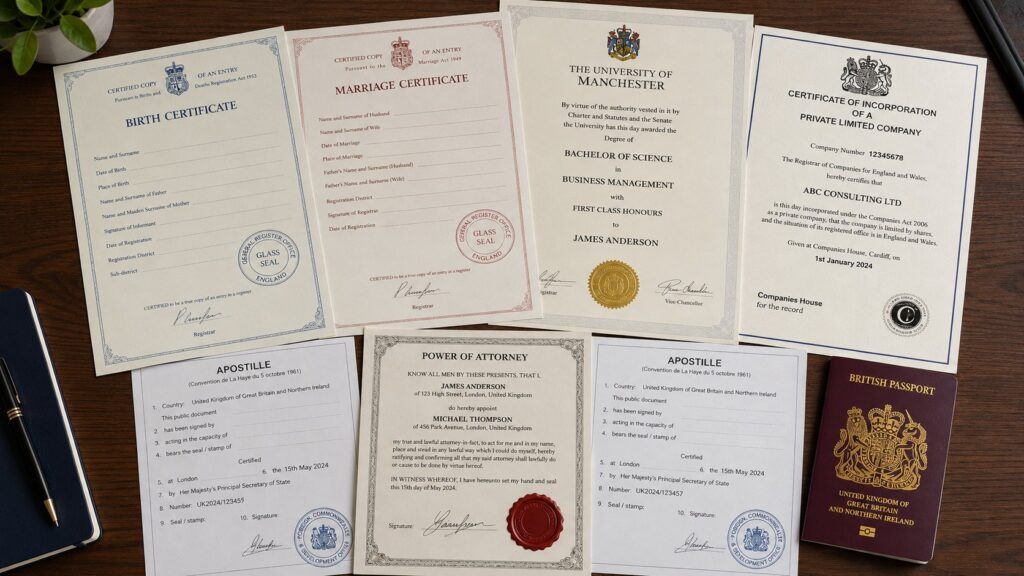
- A birth certificate
- A marriage certificate
- A degree certificate
- An academic transcript
- A company document
- A Power of Attorney
- A court document
- A statutory declaration
- A business certificate
The overseas authority may want confirmation that the document genuinely originates from the stated UK authority.
An FCDO apostille provides that authentication for documents intended for countries where the Apostille Convention applies.
Does the Apostille Itself Need to Be Translated?
In many situations, the apostille itself does not need to be translated because the apostille certificate uses a standard international format.
The heading on the apostille includes the French wording:
“Apostille (Convention de La Haye du 5 octobre 1961)”
This standardised format helps authorities identify the certificate internationally.
However, this does not mean that every foreign authority will automatically accept an English-language document without translation.
There are two separate questions to consider:
1. Does the original document need translation?
This depends on the language requirements of the receiving authority.
2. Does the apostille need translation?
This depends on whether the receiving authority requires the complete document, including the apostille, to be translated.
Therefore, it is important not to assume that an apostille never needs translation.
Who Decides Whether Translation Is Required?

The receiving authority in the destination country normally determines what it will accept.
This could be:
- An immigration department
- A foreign embassy
- A consulate
- A court
- A university
- A government ministry
- A local authority
- A bank
- A professional licensing body
- A business registry
For example, an immigration authority may state that documents must be submitted in its official language. In that situation, an English UK document may require a certified translation even though it has already received an apostille.
The apostille and translation serve different purposes. The apostille authenticates the relevant signature, seal, or certification, while the translation allows the receiving authority to understand the document.
Apostille vs Certified Translation
It is useful to understand the difference between these two services.
What Does an Apostille Do?
An apostille authenticates the relevant signature, seal, or stamp on a public document or properly certified document.
It answers a question such as:
“Is this signature, seal, or certification genuine?”
What Does a Certified Translation Do?
A certified translation provides an official translation of the document into another language.
It addresses a different question:
“Can the receiving authority understand this document in the required language?”
An apostille does not replace a translation, and a translation does not replace an apostille when both are required.
Do You Translate the Original Document or the Apostille?
Whether apostilles need to be translated for foreign authorities depends on the requirements of the organisation receiving your documents. In many cases, the apostille itself does not require translation, but the underlying UK document may need a certified translation.
For example, if a foreign authority accepts the standard apostille format but requires your birth certificate to be in its official language, you may need:
UK birth certificate → FCDO apostille → certified translation
In another situation, the receiving authority may require the complete document package to be translated, including the apostille.
This could mean:
UK document + FCDO apostille → certified translation of the complete package
There is no universal rule that applies to every destination country.
Why You Should Check Before Ordering a Translation
Ordering a translation before understanding the receiving authority’s requirements can create problems.
For example, you could pay for a translation of the original document but later discover that the authority also requires the apostille to be translated.
Alternatively, you could pay to translate the entire package when the authority only required a certified translation of the original document.
Before arranging translation, find out:
- Which documents need translation?
- Which language is required?
- Must the translation be certified?
- Does the translator need specific qualifications?
- Does the translation need notarisation?
- Does the translation itself require legalisation?
- Does the authority require the apostille to be translated?
Getting these details right can make the process much smoother.
Which UK Documents Commonly Need an Apostille?
Many types of apostille documents UK are used internationally.
Birth Certificates
Birth certificates may be required for:
- Immigration applications
- Residency applications
- Citizenship matters
- Overseas marriage
- Family registration
- Visa applications
If the receiving authority does not accept English documents, a certified translation may also be required.
Marriage Certificates
Marriage certificates are frequently used when couples move abroad or need to prove their marital status.
They may be requested for:
- Immigration
- Residency
- Spouse visas
- Family registration
- Property matters
- Government records
An apostille may authenticate the document for international use, while a certified translation may make its contents understandable to the foreign authority.
Degree Certificates
Degree certificates and other educational documents are commonly legalised for:
- Overseas employment
- University applications
- Professional registration
- Work permits
- Immigration
Some universities and professional bodies have specific translation requirements, so these should be confirmed before submitting the documents.
Business Documents
Companies may need apostilles for documents such as:
- Certificates of Incorporation
- Certificates of Good Standing
- Articles of Association
- Powers of Attorney
- Commercial agreements
- Company resolutions
If the overseas authority operates in another language, certified translation may also be required.
Legal Documents
Other documents that may require authentication include:
- Powers of Attorney
- Affidavits
- Statutory declarations
- Court documents
- Wills
- Probate documents
- Legal agreements
The correct process can depend heavily on the type of document and the country where it will be used.
How Does the Translation and Apostille Process Work?
If your UK document needs both an apostille and a translation, it is important to follow the correct process. The order can vary depending on the destination country and the organisation receiving the document.
Step 1: Identify the Receiving Authority
First, establish exactly where your document will be submitted.
The requirements of an embassy may differ from those of a university, court, immigration office, or local government department.
Ask the receiving authority whether it requires:
- An apostille.
- A certified translation.
- A notarised translation.
- Translation of the original document only.
- Translation of the apostille as well.
- Additional embassy legalisation.
This is the most important step because there is no single translation procedure that applies to every country.
Step 2: Check Whether Your Document Is Eligible for an Apostille
Not every document can simply be sent directly to the FCDO.
Public documents, such as certain certificates issued by UK authorities, may be eligible for direct legalisation.
Private documents may first need certification by an appropriate UK professional, such as a solicitor or notary.
For example, a private agreement, Power of Attorney, or certain business documents may need certification before an FCDO apostille can be issued.
Step 3: Arrange Any Required Certification
If your document needs solicitor or notary certification, this should normally be completed before submitting it for legalisation.
This is particularly important for:
- Private agreements
- Powers of Attorney
- Statutory declarations
- Affidavits
- Certain business documents
A professional apostille service UK can help identify whether additional certification is needed.
Step 4: Obtain the FCDO Apostille
Once the document meets the relevant requirements, it can be submitted to the FCDO Legalisation Office.
The FCDO checks the relevant signature, seal, or stamp and, if the requirements are met, issues the apostille.
The UK government states that an apostille can be issued as a paper certificate attached to the document or, where eligible, as an e-Apostille.
Step 5: Arrange the Required Translation
Once you understand the receiving authority’s requirements, arrange the appropriate translation.
Use a professional translator where a certified translation is required.
Depending on the destination country’s rules, the translation may need to include:
- The complete original document.
- The apostille certificate.
- Certification wording.
- Any additional attached pages.
Do not assume that a normal translation will automatically qualify as a certified translation.
Can the Apostille Be Translated Separately?
Yes, where the receiving authority specifically requires it.
However, the translation does not replace the original apostille.
A translator may translate the wording contained on the apostille as part of a complete certified translation.
The physical or electronic apostille remains the official authentication, while the translation simply communicates its contents in the language required by the receiving authority.
This distinction is important.
For example:
Original UK degree certificate → FCDO apostille → certified translation
The apostille remains attached to the document. The translated version provides the foreign authority with the information it needs in its required language.
Do e-Apostilles Need Translation?
An e-Apostille is an electronic version of an apostille that can be digitally verified.
The same basic principle applies: whether the e-Apostille needs translation depends on the requirements of the receiving authority.
Before choosing an e-Apostille, confirm that the overseas organisation is able and willing to accept and verify it.
If the authority requires a translated document, ask whether it expects:
- The document translated.
- The e-Apostille details translated.
- A certified translation of the complete electronic file.
This is particularly important when submitting documents through an online foreign government portal.
Common Mistakes When Translating Apostilled Documents
Mistake 1: Assuming Every Apostille Must Be Translated
An apostille does not automatically need translation simply because the destination country speaks another language.
Always check the receiving authority’s instructions.
Mistake 2: Assuming No Translation Is Ever Required
The opposite assumption can be equally problematic.
Even though the apostille follows an internationally recognised format, the underlying document may still need a certified translation.
Mistake 3: Using an Uncertified Translation
A standard translation may not satisfy an authority that specifically asks for a certified translation.
Check whether the translator needs to provide certification or a formal declaration.
Mistake 4: Translating Before Checking the Requirements
Do not automatically pay for translation before finding out exactly what is required.
You could end up paying for the wrong format or translating pages that do not need translation.
Mistake 5: Forgetting Additional Legalisation
An apostille may not be the final step for every destination.
If the country or authority requires additional legalisation, you may need to complete another stage after the apostille.
Frequently Asked Questions
1. Do apostilles need to be translated for foreign authorities?
Not always. An apostille follows a standard international format, but the foreign authority may require the underlying UK document, the apostille, or both to be translated. Always check the requirements of the organisation receiving your documents.
2. Does a UK document need translation before getting an apostille?
Not necessarily. The correct order depends on the document and the destination country’s requirements. In many cases, the original document is apostilled first and then translated, but some situations may require a different procedure.
3. Does the FCDO translate documents?
No. The FCDO apostille authenticates the relevant signature, seal, or stamp. It does not provide a translation of your document.
4. Can I translate the apostille myself?
If the receiving authority requires a certified translation, you should normally use a qualified translator rather than translating it yourself. The authority may have specific requirements for who can certify the translation.
5. Do birth and marriage certificates need translation after apostille?
They may do, particularly when they are being submitted to an authority that requires documents in a language other than English. The requirement depends on the destination country and receiving organisation.
6. Can an apostille service arrange translation as well?
Yes. A professional apostille service UK may be able to arrange certified translations alongside apostille and other document legalisation UK services. This can make the process easier when several stages are required.
Conclusion
An apostille does not automatically need to be translated for every foreign authority. Although the FCDO apostille follows an internationally recognised format, the receiving authority may still require a certified translation of the original document, the apostille, or the complete document package.
The safest approach is to check the requirements of the authority that will receive your documents before arranging translation. This helps you avoid unnecessary costs, incorrect translations, and delays.
If you need help with an apostille service UK, document legalisation UK, certified translation, or an FCDO apostille, 2eApostille can guide you through the process.
Learn more about our service here:
Apostille Service UK – 2eApostille
From birth and marriage certificates to degree certificates, business documents and legal paperwork, 2eApostille can help you prepare your documents correctly for international use.