
Does the apostille itself need to be translated?
Introduction
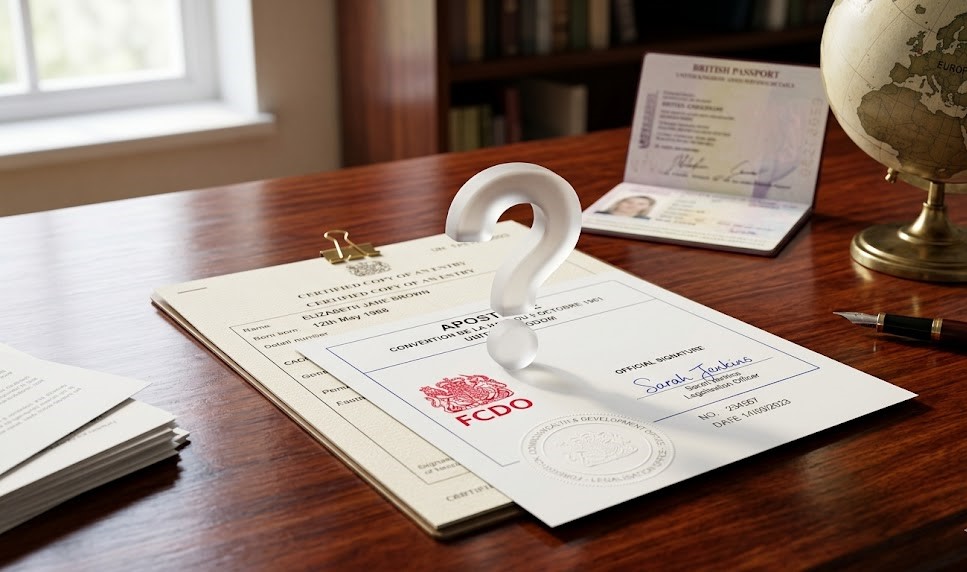
When preparing UK documents for use abroad, most people understand the need for an apostille. However, one crucial question often causes confusion: does the apostille itself need to be translated?
This question is more important than it seems. Submitting documents incorrectly—especially without the required translations—can lead to delays, rejection, or even legal complications in the destination country. Whether you are getting married overseas, applying for a visa, studying abroad, or expanding your business internationally, understanding translation requirements is essential.
In this detailed guide, we will explain everything you need to know about translating apostilles and related documents. You will learn when translation is required, how the apostille UK process works, and how to ensure your documents are accepted the first time.
What Is an Apostille Certificate?
An apostille is an official certificate that confirms the authenticity of a document issued in one country so that it can be recognised in another.
In the UK, apostilles are issued by the Foreign, Commonwealth & Development Office (FCDO). This process is commonly referred to as:
- FCDO apostille
- document legalisation UK
An apostille verifies:
- The signature on the document
- The authority of the person who signed it
- The authenticity of any seal or stamp
It does not confirm the content of the document—it only proves that the document is genuine.
Why Apostilles Are Important for International Use
When you present UK documents abroad, foreign authorities need to trust that those documents are legitimate. Without an apostille, your documents may not be accepted at all.
Common situations where you need an apostille include:
- Marriage abroad
- Visa or immigration applications
- Studying overseas
- Employment in another country
- International business transactions
However, even after obtaining an apostille, your documents may still not be accepted if they are not in the correct language.
Does the Apostille Itself Need to Be Translated?
The Short Answer
Sometimes, yes. Whether the apostille itself needs translation depends on the requirements of the country where you are submitting the document.
The Detailed Explanation
An apostille issued in the UK is written primarily in English, but it also contains standard French wording as part of the international format established by the Hague Apostille Convention.
Because of this:
- Many countries recognise the apostille without requiring translation
- However, some authorities still require a full translation of both the document and the apostille
When Translation Is Required
You will likely need to translate the apostille if:
- The destination country does not use English
- The authority specifically requests a translated version
- The document is for legal or official use (e.g. court, marriage, immigration)
When Translation Is Not Required
You may not need to translate the apostille if:
- The destination country accepts English documents
- The authority is familiar with the apostille format
- The document is being used for informal purposes
Why Do Some Authorities Require Apostille Translation?
Even though apostilles follow a standard format, not all officials are fluent in English. Translation ensures that:
- Officials clearly understand the certification details
- There is no ambiguity in legal or official contexts
- The document meets local administrative requirements
For example, in countries like France, Spain, or Italy, authorities often require translated documents to comply with local language laws.
Which Countries Typically Require Apostille Translation?

Countries That Commonly Require Translation
- France
- Spain
- Italy
- Germany
- United Arab Emirates
- China
In these countries, both the document and the apostille may need translation.
Countries That May Not Require Translation
- Ireland
- Australia
- New Zealand
- United States (in many cases)
However, requirements can vary depending on the institution, so it is always best to check in advance.
Which Documents Commonly Require Apostille and Translation?
Personal Documents
- Birth certificates
- Marriage certificates
- Divorce certificates
- Death certificates
- Adoption documents
Educational Documents
- Degree certificates
- Diplomas
- Academic transcripts
Business Documents
- Certificates of incorporation
- Articles of association
- Contracts
- Powers of attorney
Legal Documents
- Court orders
- Affidavits
- Notarised statements
These are among the most common apostille documents UK that may require translation alongside the apostille.
Should You Translate the Apostille Before or After Legalisation?
Recommended Approach: Translate After Apostille
In most cases, you should:
- Obtain the apostille on the original document
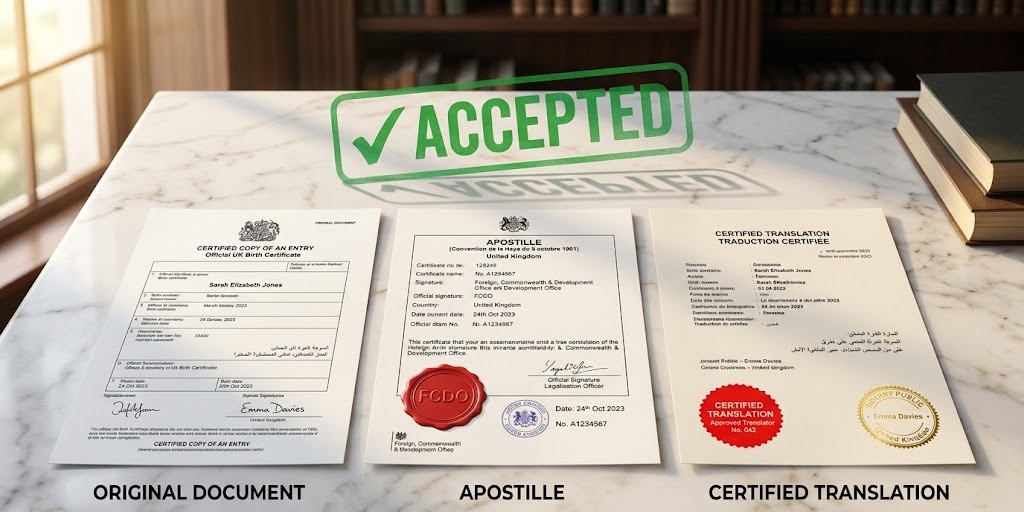
- Translate both the document and the apostille together
This ensures that the translation reflects the final, legally recognised version.
Alternative Approach: Translate Before Apostille
This may be required if:
- The translation itself needs to be apostilled
- The translator’s certification must be verified
However, this is less common.
What Type of Translation Is Required?
Certified Translation
Most countries require a certified translation, which includes:
- A statement confirming accuracy
- The translator’s details and signature
Sworn Translation
Some countries (especially in Europe) require sworn translations, completed by officially authorised translators.
Notarised Translation
In certain cases, the translation must be notarised, meaning a notary public verifies the translator’s identity and signature.
Apostille Process in the UK
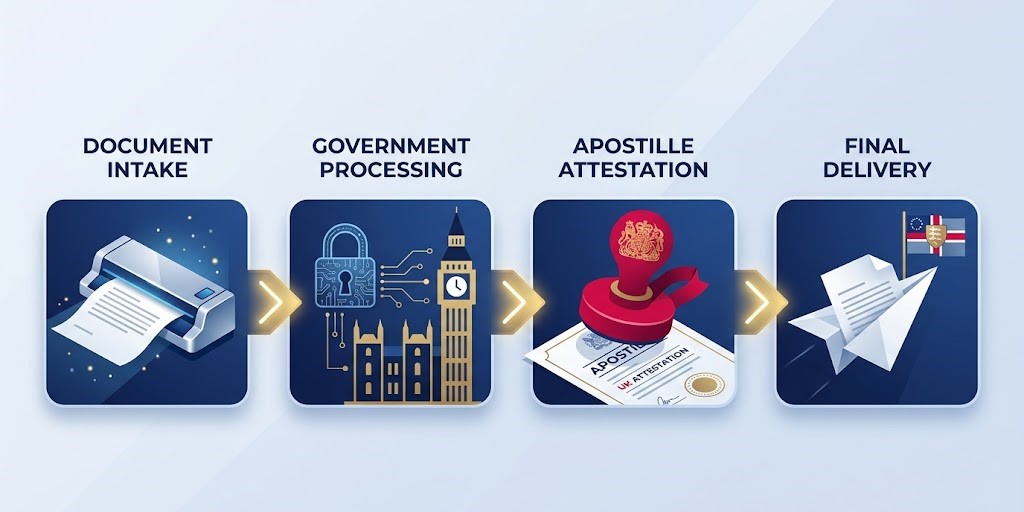
Understanding the apostille process helps you plan translation correctly.
Step-by-Step Process
- Prepare Your Document
Ensure it is an original or properly certified copy - Check Certification Requirements
Some documents require solicitor or notary certification - Submit to the FCDO
The document is verified and issued with an apostille - Receive Apostilled Document
This confirms authenticity - Translate if Required
Translate both the document and apostille if necessary
Timelines for Apostille and Translation
Apostille UK Timeline
- Standard service: 2–5 working days
- Same-day service (via agent): 1 working day
Translation Timeline
- Simple documents: 1–2 days
- Complex documents: 3–5 days
Combined Timeline
- Standard: 3–7 working days
- Urgent: 1–3 days
Using a professional apostille service UK can significantly reduce processing time.
Common Mistakes to Avoid
1. Not Translating the Apostille When Required
Some people only translate the document and forget the apostille.
2. Using Uncertified Translators
Authorities may reject translations that are not properly certified.
3. Translating Too Early
Translating before apostille can lead to inconsistencies.
4. Ignoring Country-Specific Rules
Each country has different requirements—never assume.
5. Submitting Incomplete Documents
Missing stamps, signatures, or translations can cause delays.
Why Use a Professional Apostille Service UK?
Handling apostille and translation together can be confusing, especially if you are unfamiliar with international requirements.
A professional apostille service UK can:
- Advise whether the apostille needs translation
- Ensure correct document preparation
- Handle FCDO apostille submissions
- Arrange certified or sworn translations
This reduces the risk of rejection and saves time.
For reliable assistance, visit:
https://2eapostille.co.uk/apostille-service-uk/
Practical Tips for a Smooth Process
- Always check requirements with the destination authority
- Translate both the document and apostille if required
- Use certified or sworn translators
- Keep copies of all documents
- Allow extra time for processing
- Use tracked delivery when sending documents
Frequently Asked Questions (FAQs)
1. Does the apostille always need to be translated?
No, but many countries require it, especially non-English-speaking ones.
2. Can I translate the apostille myself?
No, most authorities require certified or professional translations.
3. Should I translate before or after apostille?
Usually after apostille, but check country-specific requirements.
4. Do all countries require apostille translation?
No, English-speaking countries often do not require it.
5. What type of translation is accepted?
Certified, sworn, or notarised translations depending on the country.
6. How long does translation take?
Typically 1–3 days, depending on the document.
Conclusion
Understanding whether the apostille itself needs to be translated is essential for successful international document use. While the apostille UK process ensures authenticity, translation ensures your documents are clearly understood by foreign authorities.
Because requirements vary between countries, it is always best to check in advance and follow the correct procedure. Even a small mistake—such as not translating the apostille when required—can lead to delays or rejection.
If you want a fast, reliable, and stress-free experience, consider using a professional apostille service UK that handles both legalisation and translation requirements.
Start your process today with trusted experts at:
https://2eapostille.co.uk/apostille-service-uk/
Let professionals manage your document legalisation UK needs so your documents are accepted the first time—without delays or complications.