
Who can translate a document for apostille purposes?
Introduction
When preparing documents for use abroad, many people focus only on obtaining an apostille. However, one critical step that is often overlooked is translation. If your document is in English and the receiving country uses a different language, you will almost certainly need a certified translation alongside your apostille.
For individuals and businesses in the UK dealing with international matters—whether it’s marriage abroad, employment, study, or legal proceedings—understanding who can translate a document for apostille purposes is essential. Submitting incorrect or uncertified translations can lead to rejection, delays, and additional costs.
This guide explains everything you need to know in simple terms. From what an apostille is, to who is authorised to translate documents, and how the UK apostille process works, this article provides practical, step-by-step guidance to help you avoid common mistakes.
What Is an Apostille and When Is It Required?
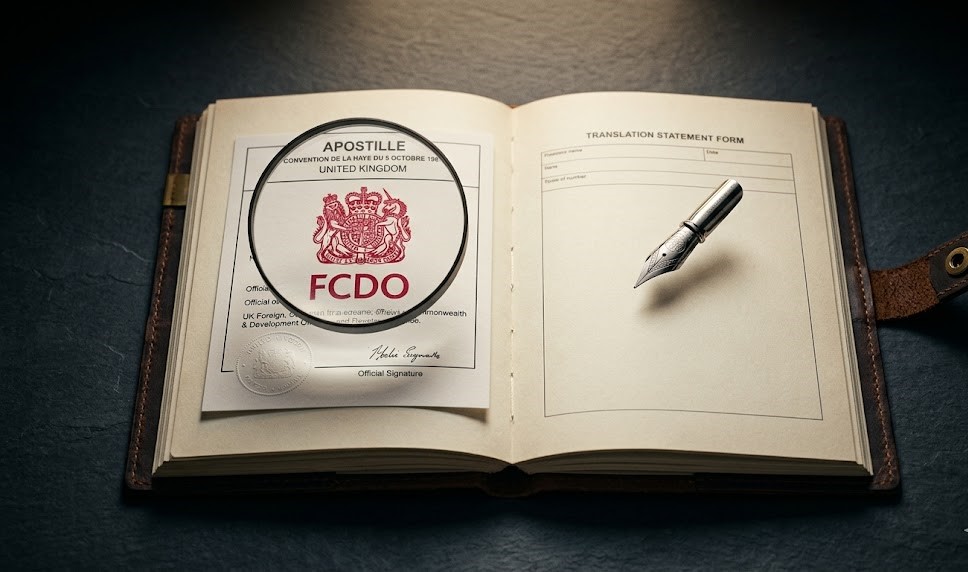
An apostille is an official certificate issued by the UK government that verifies the authenticity of a document. It confirms that the signature, stamp, or seal on the document is genuine.
In the UK, apostilles are issued by the Foreign, Commonwealth & Development Office (FCDO). This is why you will often hear the term FCDO apostille.
When Do You Need an Apostille?
You typically need an apostille when presenting UK documents in another country for:
- Marriage abroad
- Employment overseas
- Immigration or visa applications
- Studying in another country
- Business expansion or contracts
- Property transactions
If the destination country is part of the Hague Apostille Convention, the apostille is usually enough to legalise your document. However, translation is often required in addition to the apostille.
Why Translation Is Required for Apostille Documents
An apostille certifies a document’s authenticity—but it does not translate its contents.
Foreign authorities must be able to understand the document, which is why many countries require:
- The original document
- The apostille certificate
- A certified translation
For example:
- A UK birth certificate submitted in France must be translated into French
- A UK degree used in Spain must be translated into Spanish
Without proper translation, your document may be rejected—even if it has a valid apostille.
Who Can Translate a Document for Apostille Purposes?
This is one of the most important questions—and also one of the most misunderstood.
1. Certified Translators
In most cases, documents must be translated by a professional certified translator.
A certified translator will:
- Translate the document accurately
- Provide a signed statement confirming the translation is true and complete
- Include their contact details and credentials
This is often called a “certified translation” in the UK.
2. Accredited Translation Agencies
Many people use professional translation agencies because they:
- Provide certified translations accepted internationally
- Ensure accuracy and compliance
- Offer fast turnaround times
Using an agency reduces the risk of rejection by foreign authorities.
3. Sworn Translators (Outside the UK)
Some countries require translations by sworn translators (officially recognised by courts or government bodies in that country).
For example:
- France requires translations by a “traducteur assermenté”
- Spain may require a sworn translator registered with authorities
In such cases, you may need to:
- Translate in the UK first, or
- Translate after arriving in the destination country
4. Notary-Verified Translations
In certain situations, the translation may need to be:
- Signed by a translator
- Then certified by a UK notary public
This is more common for:
- Legal documents
- Court papers
- Powers of attorney
5. Can I Translate My Own Documents?
No—this is one of the most common mistakes.
You cannot translate your own documents, even if you are fluent in both languages. Authorities require an independent, certified translator to ensure accuracy and impartiality.
How the Apostille and Translation Process Works in the UK
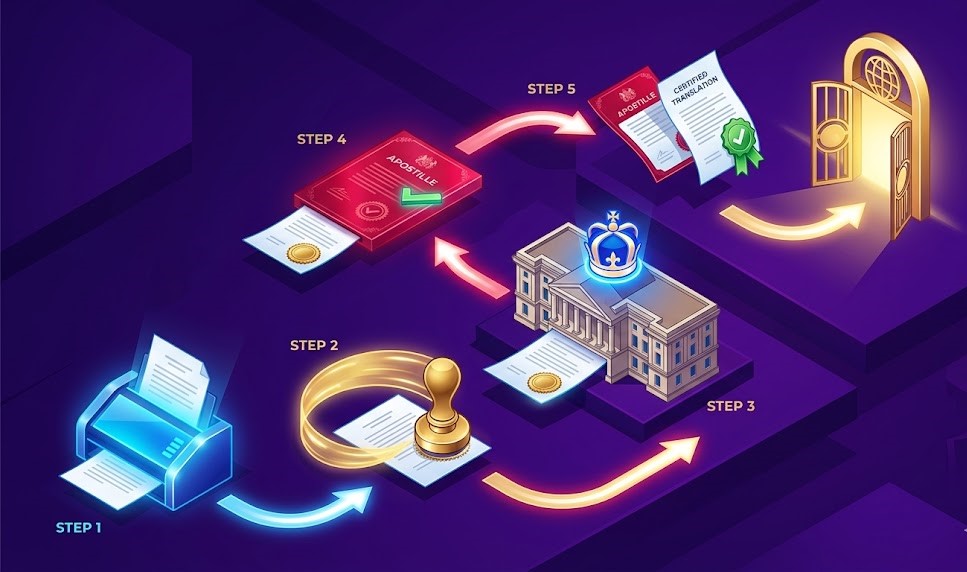
Understanding the correct order is crucial.
Step-by-Step Process
- Prepare your document
Ensure it is an original or certified copy - Get certification if needed
Some documents require solicitor or notary certification - Apply for an apostille UK
Submit the document to the FCDO - Translate the document
Use a certified translator - Legalise the translation (if required)
In some cases, the translation itself must also be apostilled
Should You Translate Before or After Apostille?
This depends on the country and document type.
Option 1: Translate After Apostille (Most Common)
- Apostille is applied to the original document
- Then the document is translated
Option 2: Translate Before Apostille
- Translation is done first
- Both original and translation may be apostilled
Always check requirements with the receiving authority to avoid delays.
Which Documents Commonly Require Translation and Apostille?
Many types of documents fall under apostille documents UK requirements.
Personal Documents
- Birth certificates
- Marriage certificates
- Divorce decrees
- Adoption certificates
- Police certificates (DBS checks)
Educational Documents
- Degree certificates
- Diplomas
- Transcripts
- Professional qualifications
Business Documents
- Certificates of incorporation
- Contracts
- Powers of attorney
- Financial statements
Legal Documents
- Court orders
- Affidavits
- Notarised declarations
Most of these documents require both apostille and translation when used abroad.
Timelines for Apostille and Translation
Apostille Processing Time
- Standard service: 2–5 working days
- Urgent service: 1–2 working days
Translation Time
- Simple documents: 1–2 days
- Complex/legal documents: 2–5 days
Combined Timeline
Typically, the full process takes:
3 to 7 working days, depending on urgency and document type.
Common Mistakes to Avoid
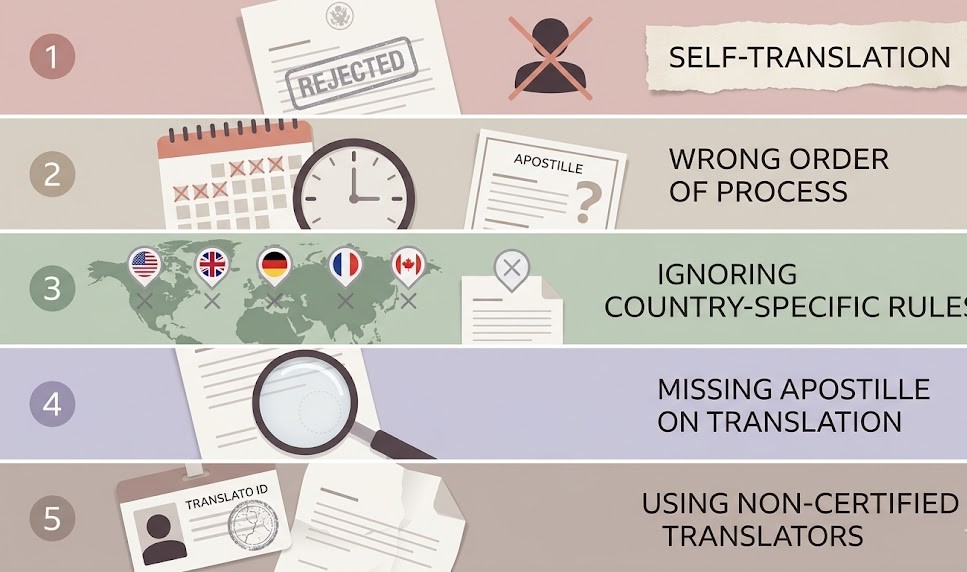
Many delays happen because of avoidable errors.
1. Using Non-Certified Translators
Unofficial translations are often rejected.
2. Translating Yourself
Self-translations are not accepted.
3. Wrong Order of Process
Applying apostille before required certification can cause rejection.
4. Ignoring Country-Specific Rules
Each country has different requirements.
5. Not Legalising the Translation
Some countries require the translated document to be apostilled as well.
Do Translations Need an Apostille Too?
In some cases, yes.
If the translation is treated as a separate legal document, it may need:
- Notary certification
- Apostille
This is common for:
- Legal agreements
- Court documents
- Business contracts
Why Use a Professional Apostille Service UK?
Handling translation and apostille together can be complex.
A professional apostille service UK can:
- Guide you on translation requirements
- Arrange certified translations
- Handle document legalisation UK
- Prevent costly mistakes
You can learn more about a complete service here:
https://2eapostille.co.uk/apostille-service-uk/
When Do You Need a Notary Instead of a Translator?
Some documents require both:
- Translation
- Notarisation
A notary is needed when:
- The document is not an official government record
- It requires legal authentication
- It will be used in legal proceedings abroad
Frequently Asked Questions (FAQs)
1. Who is legally allowed to translate documents for apostille?
A certified translator or accredited translation agency is typically required.
2. Can I translate my own document?
No, self-translations are not accepted for official purposes.
3. Do all countries require translated documents?
Most non-English-speaking countries require certified translations.
4. Does the translation need an apostille?
Sometimes, especially for legal or notarised translations.
5. Should I translate before or after apostille?
Usually after, but it depends on the destination country.
6. How long does translation and apostille take?
Typically between 3 to 7 working days.
Conclusion
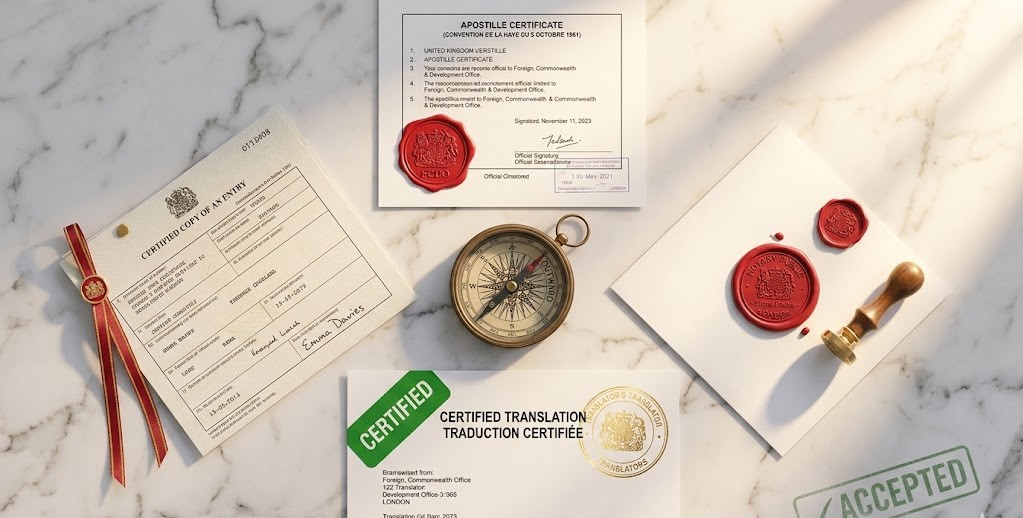
Understanding who can translate a document for apostille purposes is crucial to ensuring your documents are accepted abroad without delays. From certified translators to notarised translations, every step must be handled correctly.
If you’re unsure about the process, using a trusted provider can save you time, stress, and costly mistakes.
For a fast, reliable, and professional apostille service UK, visit:
https://2eapostille.co.uk/apostille-service-uk/
Let 2eApostille handle your document legalisation UK needs with confidence and ease.