
Adoption Certificate Apostille UK: Can It Be Apostilled?
Introduction
An adoption certificate apostille may be required when a UK adoption certificate needs to be used officially abroad. Foreign governments, immigration authorities, courts and other organisations may ask for an authenticated document before accepting it.
One of the most common questions people ask is: Can an adoption certificate be apostilled? The answer is yes, in appropriate circumstances. UK adoption certificates can be submitted for legalisation, and where the receiving country accepts an apostille, the UK Legalisation Office can attach an apostille to the document.
However, adoption certificates have an important difference compared with some other UK documents. GOV.UK confirms that adoption certificates are not eligible for an electronic e-Apostille, meaning a paper-based apostille is required.
Understanding the correct process is important because adoption documents can be sensitive and may be required for important overseas procedures. This guide explains how adoption certificates are apostilled in the UK, what documents may be required, how the process works, typical requirements, timelines and common mistakes to avoid.
If you require a trusted apostille service UK, visit our dedicated service page:
Before continuing, watch this short video explaining the apostille and legalisation process.
What Is an Apostille?
An apostille is an official certificate used to authenticate certain UK documents for use in another country.
In the UK, apostilles are issued by the Foreign, Commonwealth & Development Office (FCDO) Legalisation Office. The Legalisation Office checks the signature, stamp or seal on the document against its records. If the details can be verified, an apostille is attached to the document.
An apostille is generally used when the destination country is a member of the Hague Apostille Convention.
It is important to understand what an apostille does. It authenticates the relevant signature, stamp or seal. It does not confirm that every detail contained in the adoption certificate is correct, nor does it automatically mean that an overseas authority must accept the adoption for every legal purpose.
The receiving organisation remains responsible for deciding whether the document satisfies its own requirements.
Adoption Certificate Apostille: Can an Adoption Certificate Be Apostilled?
Yes. A UK adoption certificate can be legalised where it meets the relevant requirements.
An adoption certificate apostille can authenticate the relevant UK adoption certificate for official use in a country that accepts apostilles.
Adoption certificates are treated as public documents. GOV.UK specifically states that documents issued by a public registry, including certain official certificates, can be legalised. It also specifically lists adoption certificates among documents that cannot receive an e-Apostille.
Therefore, if an overseas authority asks for an apostilled UK adoption certificate, you should normally expect a paper-based apostille, rather than an electronic one.
This is an important distinction if you are working towards an overseas deadline.
What Is an Adoption Certificate?
An adoption certificate is an official certificate created following an adoption and can replace the original birth certificate for many official purposes.
For adoptions in England and Wales, the General Register Office provides adoption certificates. GOV.UK explains that after an adoption order is granted, the General Register Office creates an adoption certificate showing the child’s new name. A full certificate can be ordered for official purposes.
The exact document you need may depend on the purpose of your overseas application.
For example, an overseas authority may ask for:
- A full adoption certificate
- A certified copy
- An adoption order
- Evidence of parental responsibility
- Additional nationality documents
- A translation
- An apostille
- Embassy or consular legalisation
Always confirm the exact requirement before arranging an apostille UK.
Why Might an Adoption Certificate Need an Apostille?
An adoption certificate may need legalisation when it is being used officially outside the UK.
Examples can include:
International Citizenship Applications
An adoption certificate may be requested as supporting evidence in nationality or citizenship procedures.
Immigration Applications
Immigration authorities may require official evidence of family relationships or adoption.
International Adoption Matters
Where an adoption involves more than one country, authorities may request authenticated documents.
Education or Family Records
In certain circumstances, schools, universities or government organisations may request official evidence of an individual’s legal identity or family status.
Legal or Administrative Procedures
Adoption documents may also be needed for inheritance, property, court or other official matters.
The exact requirements depend on the country and the organisation receiving the document.
How to Get an Adoption Certificate Apostilled in the UK
Step 1: Check the Destination Country
Before arranging an apostille, check whether the country where you will use the document accepts apostilles.
If the destination country is a member of the Hague Apostille Convention, an apostille may be the appropriate form of authentication.
If it is not, additional legalisation may be required.
Step 2: Confirm Which Adoption Document Is Required
Do not automatically assume that any copy of your adoption paperwork will be accepted.
Ask the receiving authority whether it requires:
- A full adoption certificate
- An original certificate
- A certified copy
- An adoption order
- Additional supporting documents
For England and Wales, GOV.UK provides an application route for obtaining copies of adoption certificates through the General Register Office.
Step 3: Obtain the Correct Certificate
If you do not have a suitable certificate, obtain the appropriate official copy before starting the legalisation process.
Using an incorrect or unofficial document can cause delays.
Step 4: Submit the Document for FCDO Legalisation
Once you have the correct document, you can apply for the FCDO legalisation service.
Because GOV.UK specifically excludes adoption certificates from e-Apostille eligibility, you should use the paper-based apostille route where an apostille is required.
Step 5: Receive the Apostilled Document
After legalisation, the paper apostille will be attached to the document.
You can then provide the completed document to the overseas authority, either directly or through a courier or other delivery method.
Can an Adoption Certificate Have an e-Apostille?
No. This is an important point.
GOV.UK currently lists adoption certificates among the documents that cannot receive an e-Apostille. The same restriction applies to other General Register Office documents such as birth, death, marriage and civil partnership certificates.
Therefore, if you need an apostilled adoption certificate, you should expect a paper-based apostille.
This also means you should allow time for physical document submission and return delivery.
Do Adoption Certificates Need Notarisation?
Not every adoption certificate necessarily needs notarisation.
The correct procedure depends on the document and the requirements of the receiving authority. Official public documents may be legalised through the appropriate route without the same preparation required for certain private documents.
However, if the receiving authority specifically asks for a certified copy or notarised document, that requirement should be completed before legalisation.
Do not arrange unnecessary notarisation without first checking the requirements, as it can add cost and time.
Do Adoption Documents Need to Be Translated?
Possibly.
If the destination country’s official language is not English, the receiving authority may require a translation of the adoption certificate.
Depending on the country, it may request:
- A professional translation
- A certified translation
- A notarised translation
- The original English certificate together with the translation
- Translation of the apostille as well
The requirements vary significantly between countries.
For this reason, ask the receiving authority exactly what type of translation it accepts before arranging your document legalisation UK.
What Other Documents May Be Required?
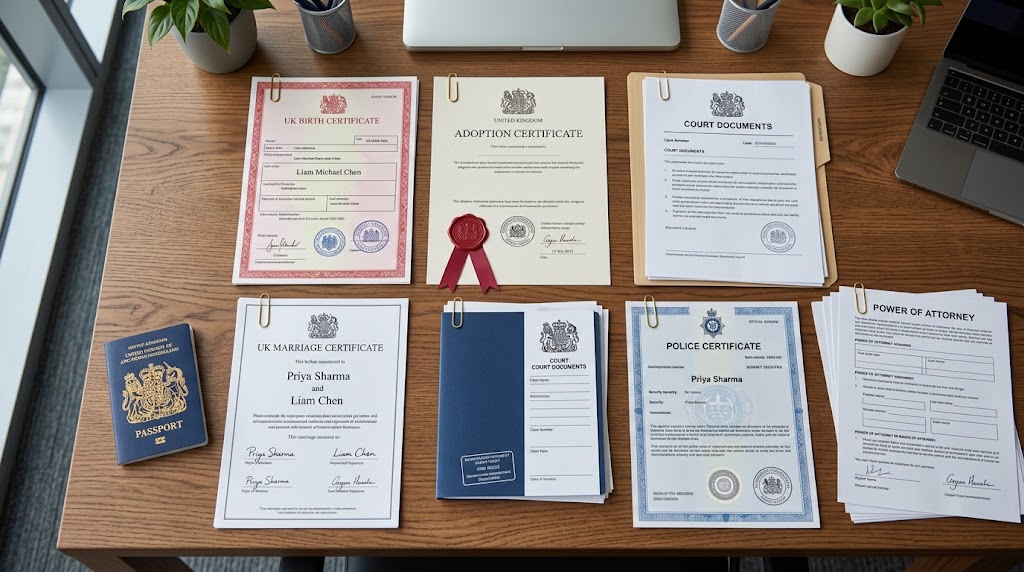
An adoption certificate may not be the only document required for an international application.
Depending on the purpose, you may also be asked for:
- Birth certificates
- Marriage certificates
- Passports
- Adoption orders
- Court documents
- Proof of nationality
- Professional documents
- Police certificates
- Powers of Attorney
- Official government letters
For example, an overseas immigration authority may require an adoption certificate together with proof of the adoptive parent’s nationality.
The apostille process authenticates the document but does not replace the receiving country’s substantive requirements.
How Long Does an Adoption Certificate Apostille Take?
The processing time depends on the legalisation service selected and the circumstances of the document.
GOV.UK currently states that the standard paper-based apostille service can take up to 25 working days, excluding delivery time. Additional urgent services may be available in specific circumstances, particularly through registered businesses.
Because adoption certificates require a paper-based apostille, you should also allow time for:
- Obtaining the certificate
- Preparing the document
- Sending it to the Legalisation Office
- FCDO processing
- Return delivery
- Translation, if required
- Embassy legalisation, if applicable
If the document is needed for a visa, citizenship or court deadline, start the process as early as possible.
Common Mistakes to Avoid
1. Requesting an e-Apostille
Adoption certificates are not eligible for an e-Apostille, so you should use the paper-based process.
2. Using the Wrong Certificate
Check whether the receiving authority wants a full adoption certificate, adoption order or another document.
3. Ignoring Translation Requirements
An apostilled English certificate may still require an approved translation.
4. Assuming an Apostille Proves the Adoption Is Recognised
An apostille authenticates the document. It does not determine whether the destination country legally recognises the adoption.
5. Forgetting Additional Legalisation
Some destinations may require embassy or consular legalisation in addition to UK document authentication.
6. Leaving the Process Too Late
Obtaining the certificate, paper apostille, translation and any further legalisation can take time.
Apostille vs Embassy Legalisation
The legalisation route depends on the destination country.
If the country accepts the Hague Apostille Convention, an apostille may be sufficient for authentication.
If the country does not accept apostilles, additional steps may be required. GOV.UK explains that non-Hague countries can involve a process including UK Legalisation Office authentication, embassy stamping and further approval by the relevant authority in the destination country.
This is why checking the destination country’s requirements before submitting an adoption certificate is essential.
How a Professional Apostille Service UK Can Help
The apostille process can be confusing when you are dealing with sensitive family or adoption documentation.
A professional apostille service UK can help you understand the practical steps involved, including document preparation, paper-based apostille requirements and possible additional legalisation.
This can be particularly useful when you are dealing with an overseas deadline or several documents at the same time.
For more information about legalising UK documents, visit the 2eApostille Apostille Service UK page.
Frequently Asked Questions
Can a UK adoption certificate be apostilled?
Yes. A UK adoption certificate can be submitted for legalisation when it meets the applicable requirements and an apostille is required by the destination country.
Can an adoption certificate receive an e-Apostille?
No. GOV.UK specifically lists adoption certificates as documents that cannot receive an e-Apostille. A paper-based apostille is therefore required where an apostille is appropriate.
Do I need the original adoption certificate?
You should check with the receiving authority. It may require an official certificate, full copy or another specific document.
Does an adoption certificate need to be translated?
It may. Translation requirements depend on the destination country and the organisation receiving the document.
Does an apostille prove that an overseas country recognises my adoption?
No. The apostille authenticates the relevant signature, stamp or seal. Recognition of the adoption is a separate legal matter.
Can I use an apostilled adoption certificate in any country?
Not necessarily. Countries have different legalisation and document requirements. Some may require an apostille, while others may require additional embassy or consular legalisation.
Conclusion
A UK adoption certificate can be apostilled when it needs to be authenticated for official use abroad. However, adoption certificates have a specific requirement: they are not eligible for an e-Apostille, so a paper-based apostille must be used where an apostille is required.
Before beginning the process, confirm the exact document required by the overseas authority and check whether you also need certification, translation or additional embassy legalisation. Preparing the correct documents from the start can help prevent unnecessary delays.
If you need assistance with an FCDO apostille, adoption certificate or other apostille documents UK, 2eApostille can help you navigate the document legalisation UK process.
Visit our Apostille Service UK page to learn more about getting UK documents prepared for international use.