
Can Photocopies of Documents Be Apostilled?
Introduction
When you need to use a UK document overseas, you may be asked to provide an apostille before a foreign authority will accept it. This often raises a crucial question regarding a photocopy apostille UK process: can a simple photocopy be legalised, or does the original document have to be used?
The answer depends on the type of document, how the copy has been prepared, and the requirements of the destination country. In many situations, a standard photocopy apostille UK request will be rejected because an apostille authenticates a signature, stamp, or seal rather than confirming the document looks genuine.
However, a properly certified copy may be eligible for a photocopy apostille UK if it meets specific criteria. This is particularly relevant when the original document is difficult to submit, when a foreign authority specifically requests a certified copy, or when the document is a private document that first needs notarisation.
If you are unsure about the correct procedure, a professional apostille service UK can help you determine what type of document is required before you submit it for legalisation.
Watch our short video for a quick explanation:
What Is an Apostille?
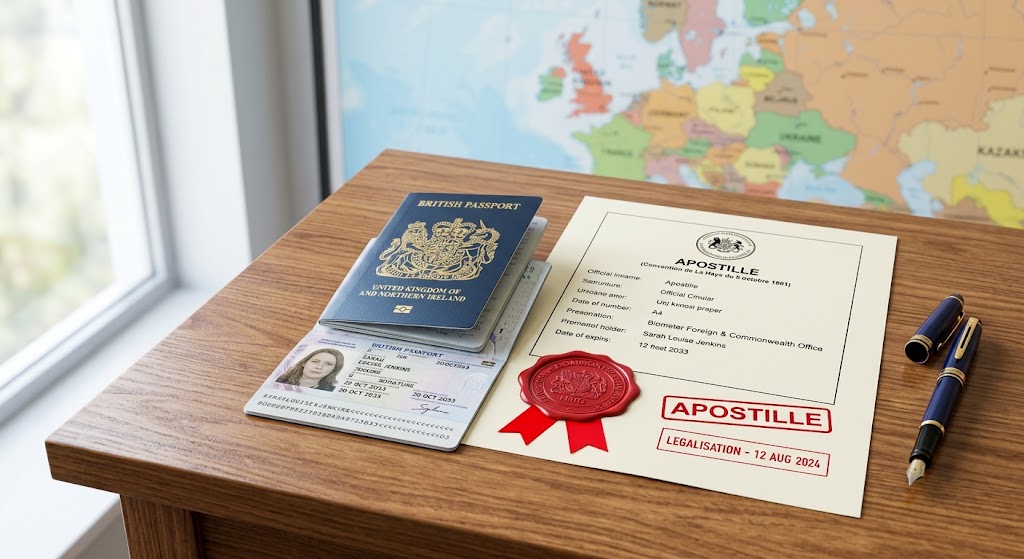
An apostille is an official certificate used to authenticate a public document for use in another country that participates in the Hague Apostille Convention.
The apostille confirms the authenticity of the signature, the capacity in which the person signing the document acted, and, where applicable, the identity of the seal or stamp on the document. It does not confirm that the information contained in the document is factually correct.
The Hague Apostille Convention was introduced to simplify the process of using public documents internationally. Instead of going through a traditional chain of embassy or consular legalisation, an apostille can generally provide the required authentication in a single step for documents being used between participating countries.
In the UK, apostilles are issued by the Foreign, Commonwealth & Development Office (FCDO) Legalisation Office.
You may need an FCDO apostille when a foreign authority, employer, university, court, business or government department asks for your UK document to be apostilled.
Can a Photocopy Be Apostilled in the UK?
Usually, No
This is the most common question we hear regarding a photocopy apostille UK request. The short answer is usually no, but there are exceptions.
For example, suppose you have an original university degree certificate and make a photocopy using a home printer. The photocopy itself generally does not become an official document simply because it is an accurate reproduction.
The Hague Apostille Handbook explains that a simple photocopy is generally not treated as a public document unless the law of the country where the document originates gives that photocopy public-document status. In many cases, the copy therefore needs to be appropriately certified before an apostille can be issued.
This is why simply sending a photocopy of your passport, certificate, degree or legal document may result in the document being rejected.
Certified Copy Apostille UK Explained
A certified copy is different from an ordinary photocopy.
Understanding the difference between a certified copy and a simple photocopy is essential for any photocopy apostille UK application. A certified copy is different from an ordinary photocopy.
A professional authorised to certify documents confirms that the copy is a true copy of the original document that they have seen. This certification is what makes a photocopy apostille UK application possible in certain circumstances.
For example, a solicitor or notary may examine your original document and certify the copy. The certification may include wording confirming that it is a true copy, together with the professional’s signature, date and relevant details.
GOV.UK explains that certified copies can be prepared by appropriate professional people, including solicitors and notaries, although the exact requirements can depend on the organisation requesting the document.
For document legalisation UK, this distinction is extremely important because the apostille may authenticate the professional’s signature or certification rather than the underlying document itself.
Original Document vs Photocopy vs Certified Copy
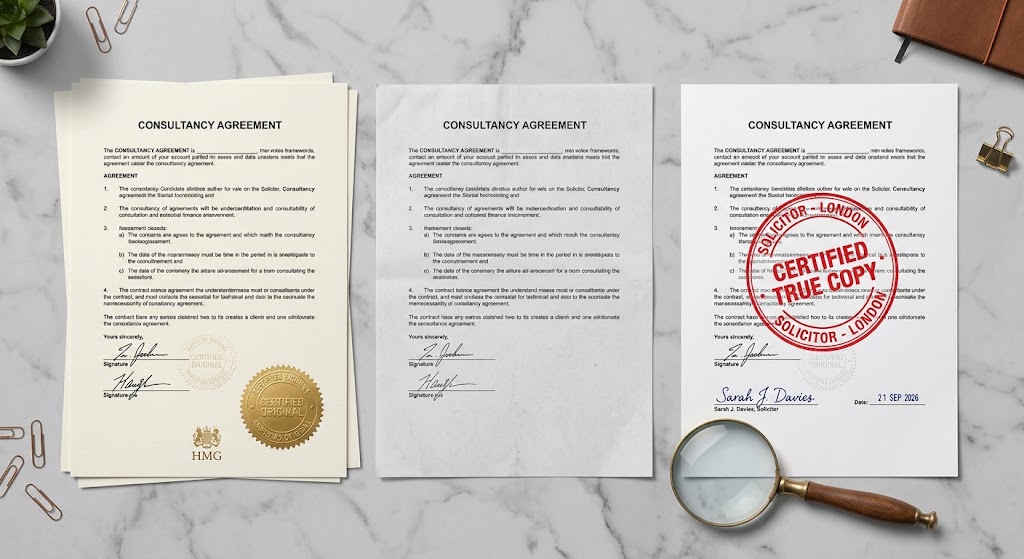
It is useful to understand the three main possibilities:
1. Original Document
This is the document officially issued by the relevant authority or organisation.
Examples include:
- Birth certificates
- Marriage certificates
- University certificates
- Certain court documents
- Companies House documents
- Government-issued documents
Where the original document contains a signature, stamp or seal that the FCDO can verify, it may be suitable for an apostille.
2. Simple Photocopy
This is an ordinary copy made from the original.
Examples include:
- A photocopy of a degree certificate
- A photocopy of a passport
- A photocopy of a birth certificate
- A scanned document printed at home
A simple photocopy will generally not be sufficient for an apostille unless the applicable law specifically recognises that copy as a public document.
3. Certified Copy
A certified copy has been checked against the original and formally certified by an appropriate professional.
Depending on the circumstances, this can allow the certification itself to be authenticated through the apostille process.
However, you should always confirm that the receiving authority accepts a certified copy before arranging one.
When Can a Certified Copy Be Apostilled?
A certified copy may be apostilled where the certification has been completed by a person whose signature or authority can be authenticated.
For example, a notary may certify a copy of a private document. The apostille may then authenticate the notary’s signature.
This is particularly relevant for documents such as:
- Private agreements
- Powers of attorney
- Certain business documents
- Copies of identification documents
- Some educational or professional documents
- Documents where the original cannot appropriately be submitted
The Hague Convention recognises that different countries have different approaches to certified copies. The law of the country of origin determines whether a copy can qualify as a public document and how it must be authenticated.
Therefore, there is no universal rule saying that every certified photocopy can automatically receive an apostille.
Which UK Documents Commonly Need Apostilles?
People request apostilles for many different documents depending on their personal, professional or business circumstances.
Birth and Marriage Certificates
Birth, marriage, death, civil partnership and adoption certificates are examples of documents issued through the UK’s registration system.
If a foreign authority asks for one of these documents to be apostilled, you should generally provide the appropriate official certificate rather than an ordinary photocopy.
University Degrees and Academic Documents
Degree certificates, diplomas and other educational documents are frequently required when people:
- Move abroad
- Apply for employment
- Continue their education
- Obtain professional recognition
- Apply for visas or residency
The receiving organisation may have specific requirements concerning the original certificate, a certified copy or verification by the issuing university.
Business Documents
Companies operating internationally may need apostilles for documents such as:
- Certificates of Incorporation
- Articles of Association
- Company certificates
- Certain commercial agreements
- Powers of attorney
- Corporate resolutions
The exact process depends on how the document was issued and whether it needs certification before legalisation.
Legal Documents
Legal documents such as powers of attorney, declarations and certain agreements may require notarisation or certification before they can receive an apostille.
This is one reason it is important to establish the correct legalisation route before submitting documents.
Photocopy Apostille UK Process (Step-by-Step)
The basic process is straightforward, but the requirements vary depending on the document.
Step 1: Check the Destination Country
First, find out whether the country where your document will be used requires an apostille.
If it is a member of the Hague Apostille Convention, an apostille may be the appropriate authentication method.
If it is not, you may need additional embassy or consular legalisation instead.
Step 2: Check Whether Your Document Is Eligible
Determine whether the FCDO can legalise the document in its current form.
Some documents may need to be certified or notarised first.
GOV.UK states that the Legalisation Office checks signatures, stamps and seals against its records before legalising eligible documents.
Step 3: Decide Between Paper and e-Apostille
The UK offers both paper-based apostilles and e-Apostilles for eligible documents.
However, not every document qualifies for an e-Apostille. GOV.UK specifically lists certain documents, including birth, marriage and other General Register Office certificates, as being ineligible for an e-Apostille.
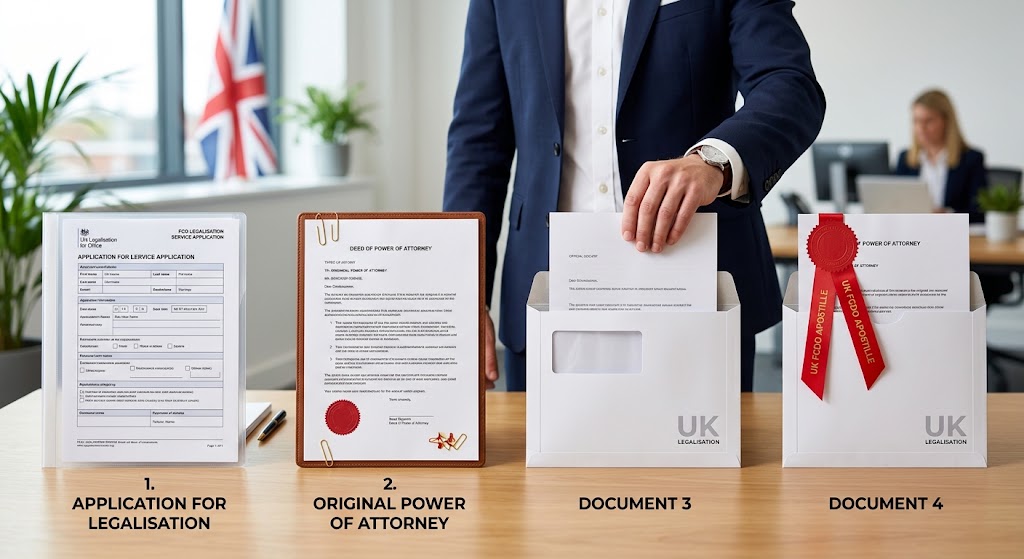
Step 4: Submit the Document
You can apply through the official legalisation process and follow the instructions for submitting your documents.
For a paper apostille, the physical document normally needs to be submitted as instructed.
How Long Does an Apostille Take?
Processing times depend on the service and the type of document.
GOV.UK currently states that standard paper-based legalisation can take up to 25 working days, while eligible e-Apostilles can take up to two working days. Additional time may be required if a signature needs further verification.
These times can change, so it is sensible to check the latest FCDO processing information before submitting important documents.
If your document needs certification or notarisation before the apostille stage, allow additional time for this step.
Common Mistakes When Apostilling Photocopies
Sending an Ordinary Photocopy
One of the most common mistakes is assuming that a photocopy is automatically equivalent to the original. A photocopy apostille UK application requires either an original or a properly certified copy—never a simple home-printed copy.
It is not.
If a certified copy is required, the copy needs to be properly certified before it is submitted.
Not Checking the Receiving Authority’s Requirements
The foreign authority may specifically request:
- An original
- A certified copy
- A notarised copy
- A paper apostille
- An e-Apostille
- A translated document
- Additional embassy legalisation
Always check what the recipient actually requires.
Assuming Every Country Uses the Same Rules
Apostille procedures are based on international arrangements, but individual authorities can have additional requirements.
The safest approach is to confirm the requirements with the organisation receiving your documents.
Using an Old or Incorrect Document
If a foreign authority has requested a recent certificate, submitting an older document may cause delays even if it can technically receive an apostille.
Does an Apostille Authenticate the Photocopy or the Original?
This depends on how the document has been prepared.
If an apostille is attached to an original public document, it generally authenticates the relevant official signature, stamp or seal on that document.
If an apostille is issued in connection with a certified copy, it may authenticate the certification or the person who certified the copy.
This distinction matters because an apostille does not automatically confirm the contents of a document. Its primary function is authentication.
Can I Apostille a Scanned Document?
A scanned copy is not automatically treated in the same way as an original public document.
The Hague Apostille Handbook notes that whether a scanned document can qualify depends on the law and practice of the country where the document originates. In some circumstances, electronic certification or notarisation may be required.
For this reason, do not assume that scanning your document and printing it will make it suitable for apostille.
Frequently Asked Questions
1. Can a normal photocopy be apostilled?
Usually, no. A simple photocopy generally does not contain an authentication that the FCDO can verify. A certified copy may be eligible in appropriate circumstances.
2. Can a certified copy receive an apostille?
Yes, a certified copy can potentially be apostilled where the certification has been completed in an acceptable manner. The apostille may authenticate the certifier’s signature rather than the original document.
3. Do I need a solicitor or notary?
Not always. Some official documents can be submitted directly for an apostille. However, private documents or copies may require certification or notarisation first.
4. Can I apostille a photocopy of my degree certificate?
A simple photocopy is generally not enough. You should check whether the receiving authority requires the original degree certificate, a certified copy or another form of verification.
5. Can photocopies of birth certificates be apostilled?
You should normally use the appropriate official certificate rather than an ordinary photocopy. Requirements can vary depending on the receiving authority and the specific document.
6. How do I know which document I should submit?
Ask the foreign authority or organisation receiving your document whether they require the original, a certified copy or another format. This can prevent unnecessary certification, legalisation costs and delays.
Conclusion
Photocopies can be useful for many administrative purposes, but a simple photocopy is not normally equivalent to an original document for apostille purposes. If a copy is required, it may need to be properly certified before the certification can be authenticated.
The most important step is to check the requirements of the foreign authority before submitting your documents. This helps ensure that you choose the correct document, certification method and legalisation process from the beginning.
Photocopies can be useful for many administrative purposes, but a simple photocopy is not normally equivalent to an original document for apostille purposes. If you are pursuing a photocopy apostille UK application, the copy must be properly certified before the certification can be authenticated.
For UK documents being used abroad, understanding the difference between an original, simple photocopy and certified copy can save time, money and unnecessary delays. A carefully prepared document is much more likely to pass the legalisation process smoothly.
If you are unsure whether your document should be submitted as an original or certified copy, professional guidance Apostille Service UK can help you choose the appropriate route before you begin the apostille process.