
When Do I Need a Notary Instead of a Solicitor?
Introduction
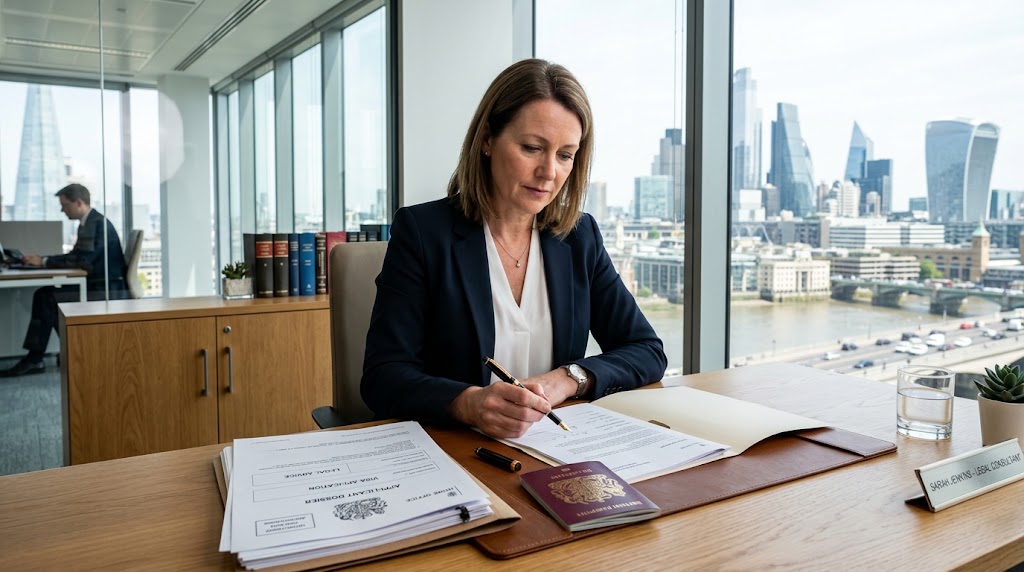
When do you need a notary instead of a solicitor? This is a common question when preparing UK documents for use abroad. Although both are qualified legal professionals, they do not always perform the same role, particularly when a document needs to be used internationally.
If you are preparing documents for a visa, overseas property transaction, marriage abroad, employment, business purposes or another legal procedure, the foreign authority may ask for a document to be notarised, certified and then legalised with an apostille.
Choosing the wrong type of certification can cause delays, additional costs or even rejection of your documents. Understanding when you need a notary instead of a solicitor can therefore make the document legalisation UK process much easier.
If you are unsure about the correct procedure, a professional apostille service UK can help you determine what type of document is required before you submit it for legalisation.
Watch our short video for a quick explanation:
What Is an Apostille?
An apostille is an official certificate issued by the UK Legalisation Office. It confirms that the signature, stamp or seal on a UK public document is genuine so that the document can be accepted for official use in another country.
An apostille is commonly required when a UK document is going to be used overseas and the receiving country is a member of the Hague Apostille Convention.
For example, you may need an FCDO apostille for a document such as a birth certificate, marriage certificate, qualification certificate, power of attorney or certain business documents.
However, not every document can be sent directly for an apostille. Some documents first need to be certified or notarised by an appropriate UK professional. This is where understanding the difference between a notary and a solicitor becomes important.
What Does a Notary Do?
A notary public is a specially qualified lawyer whose work includes authenticating and witnessing documents for use outside the UK.
A notary can perform various notarial acts, such as:
- Certifying copies of documents
- Witnessing signatures
- Verifying identities
- Certifying certain statements or declarations
- Notarising powers of attorney
- Certifying documents intended for overseas authorities
- Preparing notarial certificates
- Authenticating documents for international use
The important point is that a notary’s role often focuses on establishing the authenticity of documents, signatures and acts so they can be relied upon internationally.
This is particularly important when a foreign government, court, company, bank or other authority specifically asks for a document to be notarised by a UK notary.
What Does a Solicitor Do?
A solicitor is a qualified legal professional who normally provides legal advice and assistance with matters such as contracts, property, family law, business matters and litigation.
A solicitor can also certify certain documents or copies, depending on the requirements.
For example, a solicitor may be able to certify a copy of your passport or another document as a true copy. GOV.UK confirms that copies of documents can be certified by professionals including solicitors and notaries. However, the organisation requesting your document may have specific requirements about who must certify it.
A solicitor’s certification is therefore not automatically the same as notarisation.
If the overseas authority specifically says “notarised”, using an ordinary solicitor’s certification may not be sufficient.
Notary vs Solicitor: What Is the Difference?
The simplest way to understand the difference is to consider the purpose of the document.
A solicitor can often certify a document or provide legal services within the UK. A notary is specifically qualified to carry out notarial acts, many of which are designed for documents intended for use internationally.
You May Need a Solicitor When:
- You have been asked for a certified true copy.
- A solicitor is specifically accepted by the receiving authority.
- You need legal advice relating to a document.
- A UK organisation requires solicitor certification.
- The document does not require a formal notarial act.
You May Need a Notary When:
- The overseas authority specifically requests notarisation.
- Your document needs a notarial certificate.
- A power of attorney must be notarised for use abroad.
- A foreign bank, court or government department requires a notary.
- A signature or declaration needs to be formally witnessed for international use.
- The receiving country has specific notarisation requirements.
The most important rule is do not assume that a solicitor and notary are interchangeable. Always check exactly what the organisation receiving your document requires.
When Do I Need a Notary Instead of a Solicitor?
There is no single rule that applies to every document or country. The requirement depends on the type of document and what the overseas authority has requested.
1. Power of Attorney
Powers of attorney are one of the most common examples where notarisation may be required.
If you are giving someone authority to act for you in another country, the receiving authority may require the power of attorney to be signed or notarised before it can be used.
The document may then need an apostille or further legalisation.
2. Documents for Overseas Property Transactions
Buying, selling or managing property abroad can involve powers of attorney, declarations and contracts.
A foreign property lawyer, bank or government authority may require these documents to be notarised. In such cases, it is important to follow the exact instructions provided by the overseas authority.
3. Business and Corporate Documents
Companies sometimes need to use documents overseas for opening bank accounts, establishing companies, signing agreements or conducting international business.
Depending on the receiving country, documents such as declarations, contracts, powers of attorney and company documents may need certification or notarisation before they can receive an apostille.
4. Affidavits and Declarations
Some overseas legal procedures require you to make a formal declaration or affidavit.
Because these documents involve witnessing or formally confirming a person’s statement, a notary may be required.
5. Certified Copies for International Use
A passport, driving licence or other personal document may need to be presented as a certified copy rather than as the original.
GOV.UK states that copies of documents such as passports and driving licences can be legalised when they have been certified by an appropriate UK public official, such as a solicitor or notary.
However, the receiving authority may specifically request notarisation. If so, a notary should normally be used.
Which Documents Commonly Need an Apostille?
There are many types of apostille documents UK customers may need to prepare for overseas use.
Common examples include:
Personal Documents
- Birth certificates
- Marriage certificates
- Death certificates
- Adoption certificates
- Divorce documents
- Passport copies
- Driving licence copies
- Powers of attorney
Some public documents, such as birth and marriage certificates, may be eligible for direct legalisation because they are issued by recognised UK public authorities.
Education Documents
You may need an apostille for:
- Degree certificates
- Diplomas
- Academic transcripts
- Professional qualifications
- Certificates of education
Some qualifications require certification or notarisation before they can be legalised.
Business Documents
Business-related apostille UK requests may involve:
- Certificates of Incorporation
- Companies House documents
- Contracts
- Commercial agreements
- Company resolutions
- Powers of attorney
- Business declarations
The exact requirements can vary depending on the destination country and the purpose of the document.
How to Get an Apostille in the UK
The basic process normally involves several stages.
Step 1: Check What the Receiving Authority Requires
Before doing anything, ask the organisation abroad what it needs.
Find out whether they require:
- An original document
- A certified copy
- A solicitor’s certification
- Notarisation
- An apostille
- Embassy legalisation
- Translation
This step can prevent you from paying for the wrong service.
Step 2: Prepare the Document
Some documents can go directly to the UK Legalisation Office. Others must first be certified or notarised.
For example, a document that is not itself a recognised UK public document may require certification by a UK solicitor or notary before it can be submitted for legalisation.
Step 3: Obtain Notarisation or Certification if Required
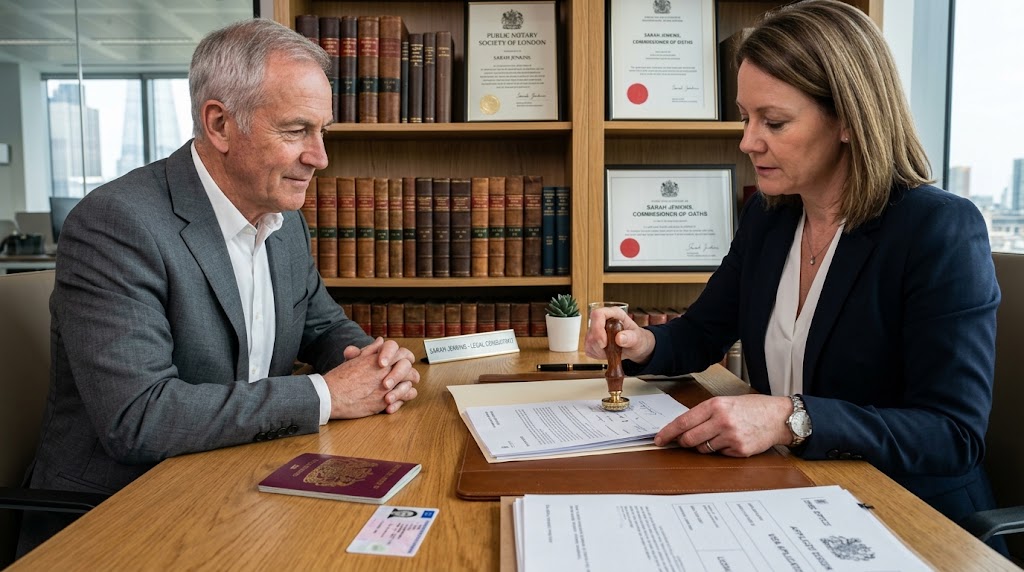
If the receiving authority specifically requests a notary, arrange an appointment with a UK notary.
Take the original document and any supporting identification or paperwork requested by the notary.
The notary will determine what notarial act is appropriate and prepare the relevant certification.
Step 4: Apply for the Apostille
Once the document has the necessary signature, certification or notarial act, it can be submitted for UK legalisation where appropriate.
The Legalisation Office checks the signature, stamp or seal against its records and, when accepted, attaches an apostille.
Step 5: Complete Further Legalisation if Required
An apostille may not always be the final step.
Some countries require additional embassy or consular legalisation after the UK apostille. This is particularly important for countries outside the Hague Apostille Convention.
Always confirm the complete process with the authority that will receive your document.
How Long Does Apostille and Notarisation Take?
The time required depends on the document, the professional involved and the legalisation service selected.
Notarisation itself may be completed during an appointment if the document is straightforward and all required information is available.
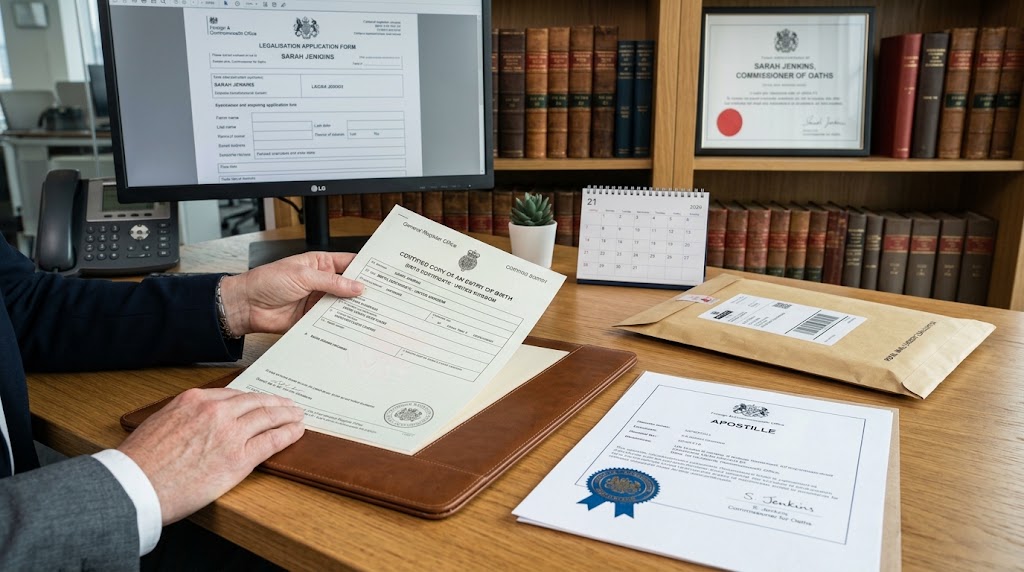
The apostille stage has separate processing times. The UK Legalisation Office offers paper-based apostilles and e-Apostilles for eligible documents, with different processing arrangements.
Paper documents also require time for postage or courier delivery.
If you have a deadline for a visa, property transaction, employment application or overseas appointment, start the process as early as possible.
An apostille service UK provider may also be able to assist with document checking, certification arrangements and submission, particularly when you need a document legalised quickly.
Common Mistakes to Avoid
Choosing a Solicitor When a Notary Was Required
If the receiving authority specifically requested notarisation, ordinary solicitor certification may not meet its requirements.
Getting the Wrong Type of Certification
Do not arrange certification before checking exactly what the overseas authority wants.
Assuming Every Document Can Be Apostilled Directly
Some documents require certification or notarisation before the FCDO can legalise them.
Ignoring Destination-Country Requirements
An apostille may be sufficient for one country but not another. Some destinations require additional legalisation.
Leaving the Process Until the Last Minute
Document legalisation can involve several stages. Allow enough time for appointments, certification, apostille processing, courier delivery and any additional embassy requirements.
Assuming a Digital Copy Is Automatically Acceptable
A scan or photograph of a document is not necessarily enough. Certain documents may need to be certified or notarised before they can be legalised.
Frequently Asked Questions
1. Is a notary the same as a solicitor?
No. A notary is a specially qualified legal professional who performs notarial acts, particularly for documents intended for international or official use. Some solicitors are also qualified notaries, but not every solicitor is a notary.
2. Do I need a notary before getting an apostille?
Not always. Some UK public documents can be submitted directly for legalisation. Other documents may need certification or notarisation first. The requirement depends on the document and the receiving authority.
3. Can a solicitor certify documents for an apostille?
Yes, in appropriate circumstances. GOV.UK confirms that certain documents can be legalised after certification by a UK public official such as a solicitor or notary. However, if the receiving authority specifically requires notarisation, you should use a notary.
4. Does a power of attorney need a notary?
It can. Many overseas authorities require powers of attorney to be notarised before they are apostilled or otherwise legalised. Always follow the instructions provided by the authority or lawyer receiving the document.
5. Can birth and marriage certificates be apostilled without a notary?
Generally, recognised UK public documents such as birth and marriage certificates can be submitted for legalisation without first being notarised. However, destination-country requirements may vary.
6. Can 2eApostille help with notarisation and apostille requirements?
Yes. If you are unsure whether your document needs certification, notarisation or an apostille, professional guidance can help you understand the appropriate process before submitting your documents.
Conclusion
Knowing whether you need a notary or solicitor is an important part of preparing documents for international use. The correct option depends on your document, the country where it will be used and the exact instructions provided by the receiving authority.
A notary is particularly important when an overseas authority specifically requires a notarised document, while a solicitor may be sufficient for certain types of certification. Once the correct certification is completed, the document may then be submitted for an FCDO apostille or further legalisation where required.
If you are unsure about the correct process, 2eApostille Services can help make your UK document legalisation process simpler and more straightforward.
Need an apostille or document legalisation for use abroad? Contact 2eApostille Services today for professional apostille support in the UK.