
Do Apostille Need to Be Translated for Foreign Authorities?
Introduction
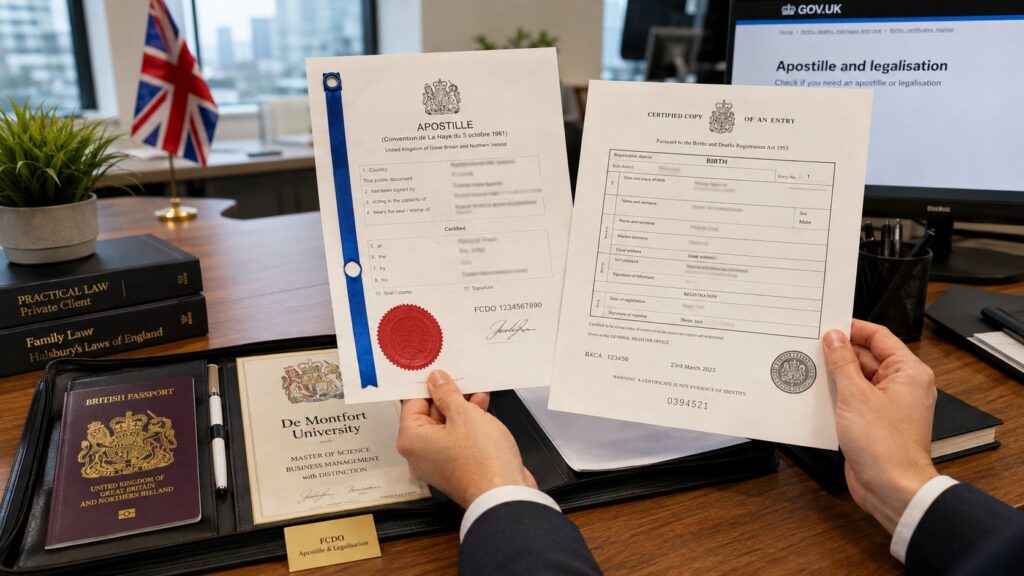
If you are preparing UK documents for use abroad, one of the most common questions is about apostille translation and whether the apostille itself needs to be translated.. This can be confusing because an apostille is attached to your original document, and the foreign authority may require documents to be presented in a language other than English.
The answer is not always. Whether an apostille needs to be translated depends mainly on the requirements of the foreign authority, court, government department, embassy, employer, university or other organisation receiving your document.
An apostille authenticates the relevant signature, stamp or seal on a UK document for use in a country that recognises the Hague Apostille Convention. It does not, by itself, guarantee that the receiving authority will accept the document without a translation.
For example, someone submitting a UK birth certificate, marriage certificate, degree certificate, police certificate, power of attorney, business document or probate document overseas may need both apostille legalisation and a certified translation. In some cases, the foreign authority may require the original English document with an apostille; in others, it may require the document and apostille to be translated into the local language.
Understanding the difference between apostille authentication and translation requirements can help you avoid delays, additional costs and the risk of having your documents rejected.
If you need help preparing documents for international use, you can learn more about the 2eApostille Apostille Service UK.
You can watch the following short video for a quick explanation related to apostille and translation requirements:
What Is an Apostille?
An apostille is an official certificate used to authenticate a UK document for use in another country that recognises the Hague Apostille Convention.
In the UK, an FCDO apostille is issued by the Foreign, Commonwealth & Development Office’s Legalisation Office.
The purpose of an apostille is to authenticate the relevant signature, stamp or seal appearing on a document. It allows the receiving authority in another participating country to verify the document’s origin more easily.
An apostille does not:
- Translate your document.
- Confirm that every statement in the document is factually correct.
- Automatically make a document acceptable for every purpose.
- Replace a translation when the receiving authority requires one.
- Automatically satisfy additional embassy legalisation requirements.
This distinction is important.
An apostille deals primarily with authentication, while translation deals with language.
Therefore, a document may need both.
Does an Apostille Need to Be Translated?
There is no single rule that applies to every country and every document.
Whether the apostille needs to be translated depends on the requirements of the authority receiving your documents.
For example, an overseas authority may state that:
The original document must be apostilled and accompanied by a certified translation.
In another situation, the authority may accept the English document and apostille without translation.
A third authority may require the entire document package, including the apostille, to be translated.
This is why it is important to check the requirements before arranging translation.
Why Might a Foreign Authority Require Translation?
Many UK documents are issued in English, while foreign authorities may operate primarily in another language.
An immigration office, court, university, bank or government department may need to understand the contents of the document before accepting it.
For example, imagine you are submitting a UK marriage certificate to an authority in a country where English is not the official administrative language.
The authority may need to understand:
- The names of the spouses
- The date of marriage
- The place of marriage
- The issuing authority
- The document’s certification
- The apostille information
A translation allows the receiving authority to understand the document and verify its contents.
Does the Original Document Need to Be Translated?
Sometimes, yes.
If a foreign authority requires a translated document, it may ask for a translation of the complete document rather than simply translating the apostille.
The requirements can differ significantly.
For example, an authority may request:
Option 1: Original Document + Apostille
The original English document is submitted with the apostille, with no translation.
Option 2: Original + Apostille + Translation
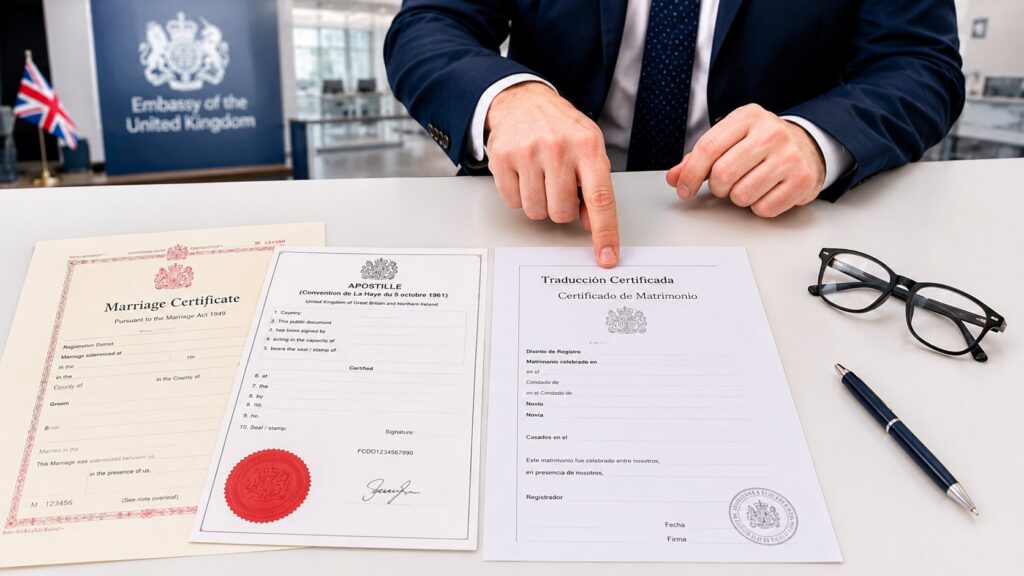
The original English document and apostille are submitted together with a certified translation.
Option 3: Translation of Document and Apostille
The foreign authority may require the contents of both the original document and apostille to be translated.
Option 4: Translated Document First
In some circumstances, the authority may have specific instructions about whether translation should take place before or after authentication.
Because these requirements vary, you should follow the instructions provided by the organisation receiving your documents.
Should the Apostille Be Translated Separately?
An apostille may need to be translated if the receiving authority requires the entire document package to be in its official language.
The apostille contains information such as:
- Country
- Name of the signatory
- Capacity of the signatory
- Details concerning the seal or stamp
- Place of issue
- Date
- Apostille number
- Official authority information
Although the apostille follows a standard international format, this does not necessarily mean every foreign authority will accept it without translation.
Some authorities may accept the standard apostille as it is. Others may require a translation.
Do not assume that the international format automatically removes the need for translation.
The receiving authority has the final say on what it will accept for the intended purpose.
What Is a Certified Translation?
A certified translation is a translation accompanied by a declaration or certification from the translator or translation provider confirming the accuracy of the translation.
However, the meaning of “certified translation” can vary between countries.
A foreign authority may require:
- A certified translator
- A sworn translator
- A notarised translation
- A translation completed by a translator recognised by the destination country
- A translation certified by a particular organisation
Therefore, simply translating a document yourself or using an ordinary translation service may not satisfy the foreign authority.
Always check what type of translation is required.
Which UK Documents Commonly Need Translation?
Many different types of apostille documents UK may require translation depending on their intended destination.
Birth Certificates
UK birth certificates are frequently used overseas for:
- Immigration
- Marriage applications
- Citizenship applications
- Residency
- Family reunification
- Visa applications
If the receiving authority operates in another language, a translation may be required alongside the apostille.
Marriage Certificates
Marriage certificates may be required when applying for:
- Residency
- Family visas
- Citizenship
- Immigration
- Overseas marriage registration
The authority may require the certificate and apostille to be translated.
Degree Certificates
Graduates moving abroad for employment or education may be asked to provide legalised academic documents.
These can include:
- Degree certificates
- Diplomas
- Academic transcripts
- Certificates of qualification
Translation requirements depend on the university, employer or government authority receiving them.
Police Certificates and DBS Checks
Police certificates may be required for overseas employment, immigration and residency applications.
If the destination country’s official language is not English, the authority may request a certified translation.
Business Documents
Companies may need to legalise documents such as:
- Certificates of incorporation
- Company resolutions
- Commercial agreements
- Powers of attorney
- Certificates of good standing
- Business contracts
Translation requirements can be particularly important when documents are being submitted to foreign commercial or government authorities.
Wills and Probate Documents
International estates may involve:
- Wills
- Grants of Probate
- Letters of Administration
- Court documents
- Death certificates
A translation may be required if these documents are being presented to a foreign court, bank or estate authority.
Apostille First or Translation First?
This is one of the most important practical questions.
There is no universal sequence that applies to every document and every country.
The correct order depends on what the receiving authority requires.
In some situations, the original English document is apostilled and then translated.
In other situations, a translation may need to be certified and then legalised.
For certain documents, the receiving authority may have specific instructions about how the translation should be attached to the original document.
Therefore, before proceeding, ask the receiving authority:
- Does the document require an apostille?
- Does the document require translation?
- Does the apostille itself need translation?
- Does the translation need to be certified?
- Does the translator need to be officially recognised?
- Should translation happen before or after apostille?
- Is further embassy legalisation required?
Getting these answers first can prevent you from having to repeat the process.
How the UK Apostille Process Works
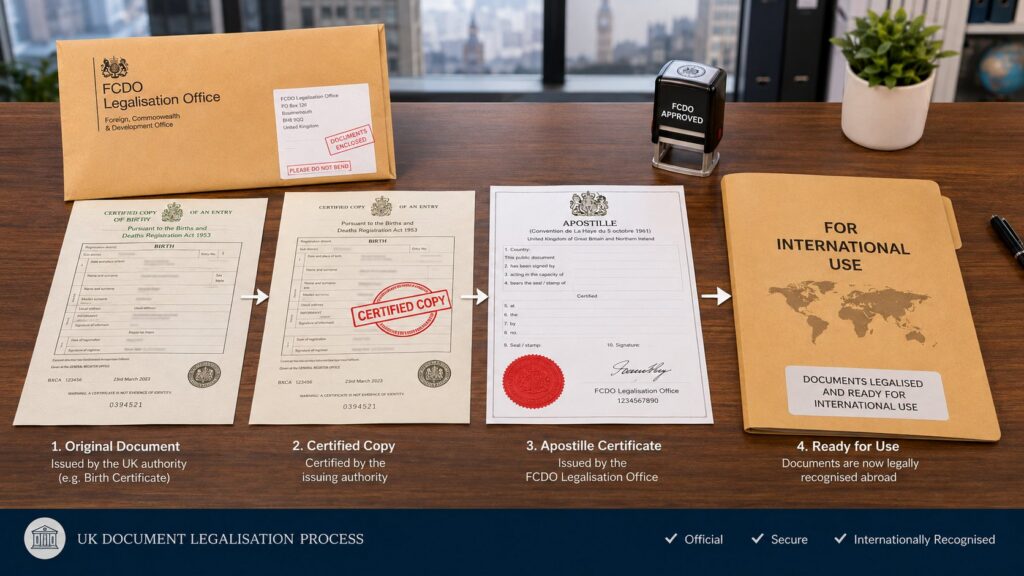
Step 1: Identify the Document
First, determine exactly which document you need to use overseas.
It could be a:
- Birth certificate
- Marriage certificate
- Degree certificate
- Police certificate
- DBS certificate
- Power of attorney
- Will
- Probate document
- Business document
- Court document
Step 2: Check the Destination Requirements
Contact the foreign authority or check its official instructions.
Confirm whether it requires:
- Apostille
- Translation
- Certified translation
- Notarisation
- Embassy legalisation
- A specific document format
This is an essential part of document legalisation UK.
Step 3: Prepare the Document for Apostille
Some documents can be submitted directly for legalisation, while others may require certification first.
The exact requirements depend on the document.
Step 4: Obtain the FCDO Apostille
Once the document is suitable for legalisation, it can be submitted for an FCDO apostille.
The apostille authenticates the relevant signature, seal or stamp.
Step 5: Complete Translation Requirements
If translation is required, arrange the appropriate certified translation.
Make sure the translator understands whether the apostille also needs to be translated.
Step 6: Submit the Complete Document Package
Once all required steps are complete, submit the documents to the foreign authority.
Keep copies of everything submitted, including:
- Original documents
- Apostille
- Translation
- Certification
- Courier receipts
- Application forms
How Long Does Apostille and Translation Take?
The overall timeframe depends on the document, apostille service, translation requirements and destination country.
Factors that can affect processing include:
- Whether certification is required
- FCDO processing times
- Translation availability
- Translator certification
- Courier delivery
- Embassy processing
- Additional legalisation
If your documents are needed for a visa, university application, employment contract or immigration deadline, start the process as early as possible.
Translation should not be treated as an afterthought because a certified translation can add additional time.
Common Mistakes to Avoid
1. Assuming Every Apostille Needs Translation
Not every apostille requires translation.
Check the receiving authority’s instructions.
2. Assuming No Translation Is Needed
The opposite mistake can also cause problems.
If the authority requires a certified translation and you submit only the English document, your application could be delayed.
3. Translating Only the Main Document
The authority may require the apostille itself to be translated as well.
Confirm this before arranging translation.
4. Using an Ordinary Translation
A foreign authority may require a certified or sworn translation rather than a standard translation.
5. Translating at the Wrong Stage
Some authorities have specific requirements regarding the order of translation, certification and legalisation.
6. Ignoring Embassy Requirements
An apostille may not always be the final step. Some destinations can require additional legalisation depending on the circumstances.
Apostille vs Translation: What Is the Difference?
It is useful to remember the distinction:
| Apostille | Translation |
|---|---|
| Authenticates a signature, stamp or seal | Converts the document into another language |
| Issued through the relevant legalisation authority | Completed by a translator |
| Used for international document authentication | Used to help the receiving authority understand the document |
| Does not translate the document | Does not automatically authenticate the original |
| May be required under the Hague Apostille Convention | Depends on the language requirements of the receiving authority |
In many international applications, both processes may be required.
Frequently Asked Questions
1. Does an apostille need to be translated?
Not always. It depends on the requirements of the foreign authority receiving the document.
2. Does the original document need to be translated?
It may need to be translated if the receiving authority requires documents in its official language.
3. Does the apostille itself need translation?
Sometimes. If the authority requires the complete document and authentication to be presented in another language, the apostille may also need to be translated.
4. Does a translation need to be certified?
This depends on the destination country and receiving authority. Some require certified or sworn translations, while others may accept different forms of translation.
5. Should I translate my document before getting an apostille?
There is no universal rule. The correct order depends on the document and the requirements of the receiving authority.
6. Can 2eApostille help with apostille and translation requirements?
A professional apostille provider can help you understand the relevant legalisation process and identify whether additional certification or translation may be required for your intended destination.
Conclusion
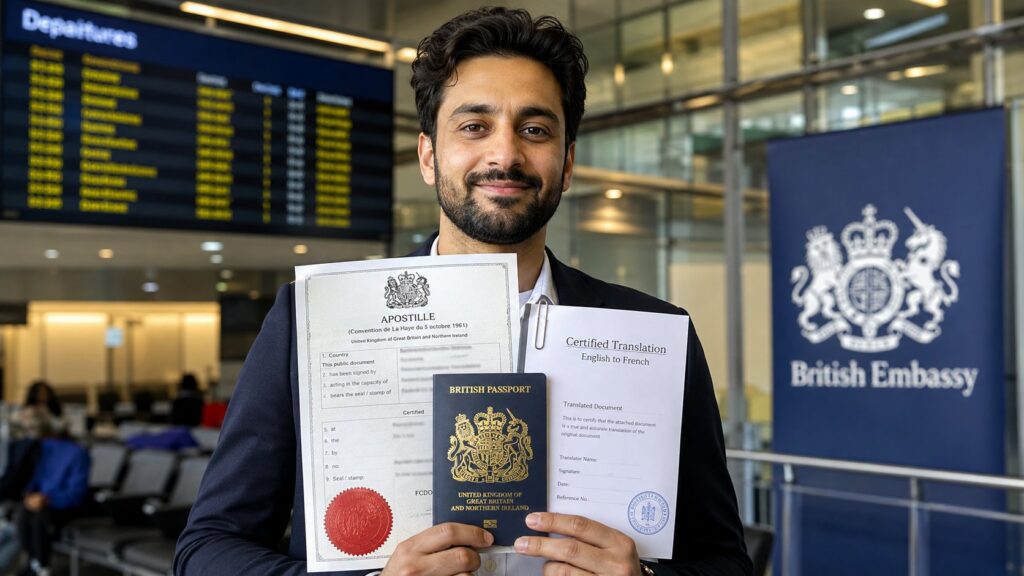
Whether an apostille needs to be translated depends on where your document is going, why it is being used and what the receiving authority requires.If you need help with apostille translation, an FCDO apostille or UK document legalisation, it is important to check the requirements of the destination country before submitting your documents. An apostille authenticates the relevant signature, stamp or seal on a document, while a translation makes the document understandable to an authority operating in another language. These are separate requirements, and one does not automatically replace the other.
Before arranging an apostille or translation, confirm exactly what the foreign authority wants. Check whether it requires the original document, an apostille, a certified translation, translation of the apostille itself, or additional embassy legalisation. It is also important to check whether there are specific requirements concerning the translator or the order in which authentication and translation must be completed.
For anyone preparing apostille documents UK for international use, careful preparation is one of the most effective ways to make the process smoother. Once you know the exact requirements of the destination country, you can arrange the appropriate apostille, certification and translation without completing unnecessary steps.