
Can I Use a UK Apostille in the EU?
Introduction
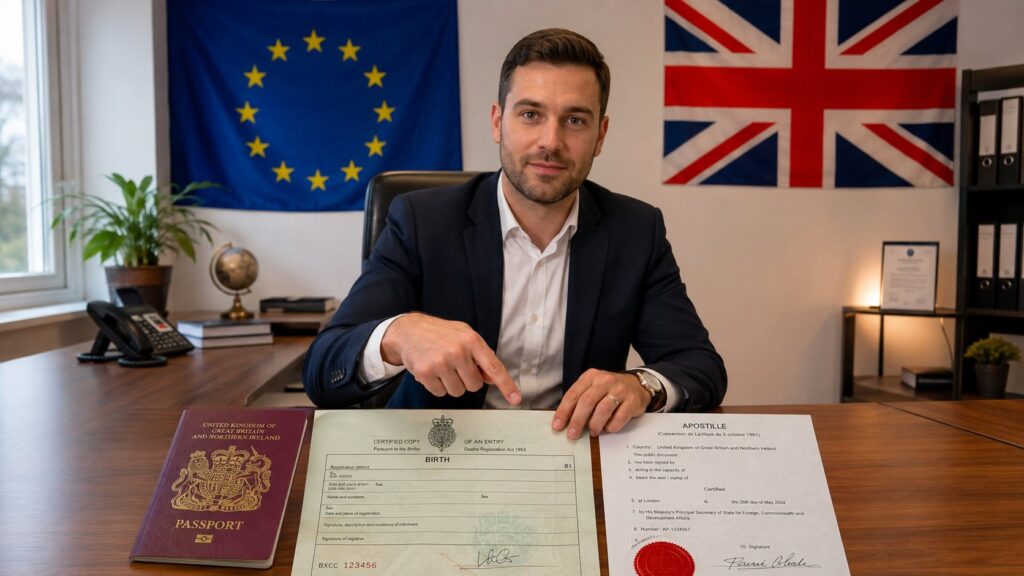
Can I Use a UK Apostille in the EU? This is one of the most common questions people ask before moving, studying, working, marrying, or doing business in a European Union country. The answer is often yes, but it depends on the country, the type of document, and the purpose for which it will be used.
Since the UK is no longer part of the European Union, many people are unsure whether UK-issued documents still require legalisation for use in EU member states. In many situations, an FCDO apostille is required to prove that your UK document is genuine before it can be accepted by authorities abroad. Some countries may also request certified translations or additional supporting documents depending on their local regulations.
Whether you need to legalise a birth certificate for residency, a degree certificate for employment, a marriage certificate for family registration, or business documents for commercial purposes, understanding the legalisation process can help you avoid delays and ensure your documents are accepted the first time.
If you are looking for a reliable apostille service UK, visit our dedicated service page:
Before reading further, watch this short video explaining the apostille process and how it helps prepare UK documents for international use.
What Is an Apostille?
An apostille is an official certificate issued by the Foreign, Commonwealth & Development Office (FCDO) that confirms the authenticity of a UK public document or a properly certified private document. It verifies that the signature, seal, or stamp on the document belongs to an authorised official.
An FCDO apostille does not validate the content of the document. Instead, it confirms that the document itself is genuine, making it suitable for legal recognition in countries that accept apostilles under the Hague Apostille Convention.
Many foreign authorities require an apostille before they will accept UK documents for immigration, education, employment, marriage, legal proceedings, or business activities.
Can I Use a UK Apostille in the EU?
In most cases, yes. Many European Union countries are members of the Hague Apostille Convention, which means they recognise apostilles issued by the UK. If your document has been correctly legalised with an FCDO apostille, it is generally accepted by authorities in those countries.
However, acceptance also depends on:
- The purpose of the document.
- The specific requirements of the receiving authority.
- Whether the document needs to be translated.
- Whether additional local procedures apply.
For example, a university, employer, court, or government office may have its own documentation requirements in addition to the apostille.
When Might You Need an Apostille for Use in the EU?
There are many situations where UK documents need to be legalised before they can be used in an EU country.
Common examples include:
- Applying for a work visa.
- Accepting employment overseas.
- Studying at a European university.
- Registering a marriage.
- Applying for dual nationality or residency.
- Purchasing property abroad.
- Registering a birth.
- Opening a business.
- Handling legal or probate matters.
Having the correct document legalisation UK completed before travelling can save considerable time and prevent delays with overseas authorities.
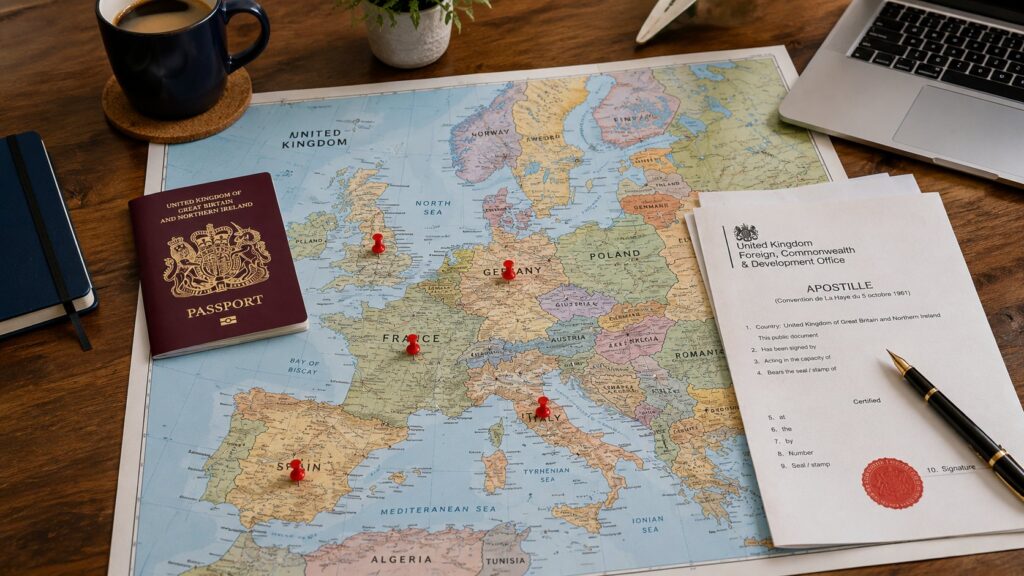
Which EU Countries Commonly Accept a UK Apostille?
Many EU member states recognise UK apostilles because they are parties to the Hague Apostille Convention.
Examples include:
- France
- Germany
- Spain
- Italy
- Portugal
- Netherlands
- Belgium
- Ireland
- Poland
- Sweden
- Denmark
- Finland
- Austria
- Greece
- Czech Republic
- Hungary
- Romania
- Croatia
Although these countries generally recognise apostilles, individual organisations may still request additional documents, certified translations, or recently issued certificates.
For this reason, it is always advisable to check the specific requirements of the organisation requesting your documents.
Which Documents Commonly Require an Apostille?
Many different apostille documents UK are used within EU countries.
Personal Documents
These include:
- Birth certificates
- Marriage certificates
- Death certificates
- Civil partnership certificates
- Adoption certificates
- Deed Poll name change certificates
These documents are commonly needed for immigration, residency applications, family registration, and overseas marriages.
Educational Documents
Students and professionals often require legalised educational documents.
Examples include:
- Degree certificates
- Diplomas
- Academic transcripts
- Professional qualifications
- Teaching certificates
Many European universities and employers request these documents before accepting applications.
Employment Documents
Employment-related documents include:
- Employer reference letters
- Employment contracts
- Professional licences
- Experience certificates
- Salary confirmation letters
Some of these documents require certification by a solicitor before receiving an apostille.
Business Documents
Companies expanding into Europe frequently require legalisation for:
- Certificate of Incorporation
- Articles of Association
- Certificates of Good Standing
- Commercial agreements
- Company resolutions
- Powers of Attorney
Business legalisation helps overseas authorities verify that UK company documents are authentic.
How Do You Obtain an Apostille in the UK?
If you need to use your UK documents in an EU country, obtaining an FCDO apostille is usually a straightforward process when you understand the requirements. Following the correct steps ensures your documents are accepted without unnecessary delays.
Step 1: Identify the Documents You Need
The first step is to determine which documents require legalisation. Different organisations within the EU may ask for different paperwork depending on your reason for travelling or relocating.
Common apostille documents UK include:
- Birth certificates
- Marriage certificates
- Death certificates
- Degree certificates
- Academic transcripts
- Employer reference letters
- DBS certificates
- Powers of Attorney
- Medical certificates
- Company documents
Before submitting anything, check exactly what the receiving authority requires.
Step 2: Check Whether Certification Is Needed
Not every document can be sent directly to the Foreign, Commonwealth & Development Office (FCDO).
Original public documents, such as UK birth or marriage certificates, can usually be apostilled immediately.
Private documents often need certification by a solicitor or notary public first. These may include:
- Passport copies
- Employment letters
- Business agreements
- Academic copies
- Affidavits
- Consent letters
Preparing your documents correctly helps avoid rejection during the legalisation process.
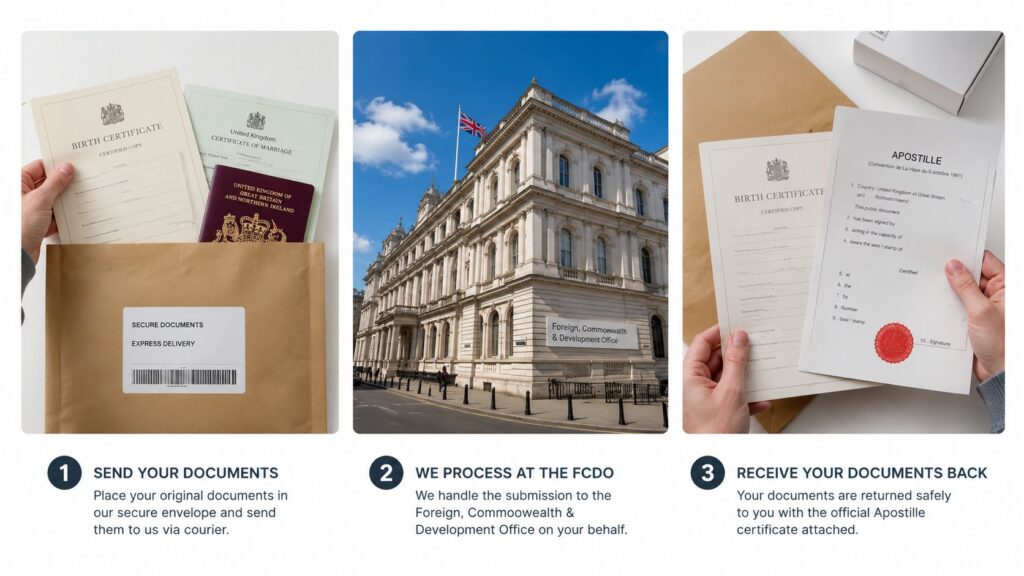
Step 3: Apply for the FCDO Apostille
Once your documents are ready, they are submitted to the Foreign, Commonwealth & Development Office for authentication.
The FCDO verifies:
- The official signature.
- The government seal or stamp.
- The authority of the person who signed the document.
If everything is correct, the official apostille certificate is attached to your document.
For most EU countries, this is the final stage of the legalisation process.
Step 4: Arrange Certified Translation (If Required)
Although many EU countries accept English documents, some authorities require certified translations into their official language.
Examples include:
- French
- German
- Spanish
- Italian
- Portuguese
- Dutch
- Polish
Whether a translation is needed depends on the receiving organisation rather than the apostille itself. Always confirm the language requirements before submitting your documents.
How Long Does the Apostille Process Take?
Processing times depend on several factors, including:
- The type of document.
- Whether solicitor certification is required.
- FCDO processing times.
- Courier delivery.
- The urgency of your application.
If you have strict deadlines for employment, university enrolment, immigration, or business registration, it is advisable to begin the process as early as possible.
Many professional apostille service UK providers also offer priority services for urgent applications.
Common Reasons People Need a UK Apostille in the EU
Working in Europe
Employers often ask applicants to provide legalised documents before employment begins.
These may include:
- Degree certificates
- Professional qualifications
- DBS certificates
- Employment references
Having an FCDO apostille helps demonstrate that these documents are genuine.
Studying Abroad
Universities throughout Europe frequently request legalised educational documents.
Students may need:
- Degree certificates
- Academic transcripts
- A-Level certificates
- GCSE certificates
- Professional qualifications
Some institutions may also require certified translations.
Marriage Abroad
If you are planning to marry in an EU country, local authorities may request:
- Birth certificate
- Certificate of No Impediment
- Divorce documents (if applicable)
- Deed Poll documents
- Passport copies
Each country has its own marriage registration requirements, so always check in advance.
Moving Overseas
Residency and immigration applications often require:
- Birth certificates
- Marriage certificates
- Police certificates
- Medical reports
- Adoption certificates
Legalising these documents before travelling helps avoid unnecessary delays with immigration authorities.
Business Expansion
Companies operating across Europe regularly need legalised commercial documents.
Examples include:
- Certificate of Incorporation
- Articles of Association
- Certificates of Good Standing
- Commercial contracts
- Board resolutions
- Powers of Attorney
Using professional document legalisation UK services helps businesses complete international transactions more efficiently.
Common Mistakes to Avoid
Many applications are delayed because applicants make avoidable errors.
Assuming Every EU Country Has the Same Rules
Although many EU countries recognise apostilles, individual organisations may have additional requirements such as certified translations or recently issued certificates.
Sending Certified Copies Instead of Originals
Some authorities only accept original documents, while others accept certified copies. Always verify what is required before applying.
Waiting Until the Last Minute
Even though obtaining an apostille is usually straightforward, processing times can vary. Applying early reduces stress and avoids missed deadlines.
Forgetting Translation Requirements
Some documents must be translated by a certified translator before they can be accepted abroad.
Using an Outdated Certificate
Certain authorities require recently issued birth, marriage, or company certificates rather than older originals. Check whether there are any validity requirements before submitting your documents.
Why Choose a Professional Apostille Service UK?
Using an experienced apostille service UK makes the legalisation process faster, simpler, and less stressful.
Professional providers can:
- Review your documents before submission.
- Confirm whether certification is required.
- Arrange solicitor or notary certification.
- Obtain your FCDO apostille.
- Advise on translation requirements.
- Provide secure tracked return delivery.
- Offer guidance tailored to your destination country.
With expert assistance, you can be confident that your documents are prepared correctly and ready for use throughout the European Union.
Frequently Asked Questions
1. Can I use a UK apostille in EU countries?
Yes. Most EU countries recognise a UK apostille because they are members of the Hague Apostille Convention. However, individual authorities may also require certified translations or additional supporting documents.
2. Which documents usually need an apostille for use in the EU?
Common apostille documents UK include birth certificates, marriage certificates, degree certificates, academic transcripts, business documents, Powers of Attorney, and employer reference letters.
3. Do I need to translate my apostilled documents?
Possibly. Some EU authorities accept documents in English, while others require certified translations into their official language. Always check the requirements of the receiving organisation.
4. How long does it take to obtain an FCDO apostille?
Processing times vary depending on the document type, whether solicitor certification is required, and current FCDO processing times. If your documents are urgent, a professional apostille service UK can advise on the fastest available option.
5. Do all UK documents need solicitor certification before an apostille?
No. Original public documents, such as birth and marriage certificates, usually do not require certification. Private documents, such as employment letters or business agreements, often need to be certified by a solicitor or notary before an apostille can be issued.
6. Can a professional apostille service help with the entire process?
Yes. An experienced apostille service UK can review your documents, arrange certification where required, obtain the FCDO apostille, advise on translation requirements, and organise secure return delivery.

Conclusion
If you need to use UK documents in a European Union country, obtaining an FCDO apostille is often an essential step in ensuring they are recognised by overseas authorities. Whether you are relocating for work, enrolling at a university, getting married, applying for residency, or expanding your business, having your documents properly legalised helps avoid unnecessary delays and gives you confidence that your paperwork will be accepted.
Although most EU countries recognise UK apostilles under the Hague Apostille Convention, individual organisations may have additional requirements. These can include requesting recently issued certificates, certified translations, or supporting documentation depending on the purpose of your application. Taking the time to understand these requirements before submitting your documents can save both time and money.
Common apostille documents UK include birth certificates, marriage certificates, degree certificates, academic transcripts, employment letters, Powers of Attorney, and business documents. Some of these documents can be submitted directly for an apostille, while others require certification by a solicitor or notary public beforehand. Seeking professional advice ensures your documents are prepared correctly and helps minimise the risk of delays or rejection.
If you are looking for a trusted apostille service UK or need assistance with document legalisation UK, 2eApostille is here to help. Our experienced team provides expert guidance throughout every stage of the legalisation process, from reviewing your documents and arranging certification where necessary to obtaining your FCDO apostille quickly and securely.
To learn more or begin your application today, visit our Apostille Service UK page:
Whether you need to legalise personal, educational, legal, or commercial documents for use in the European Union, 2eApostille offers a fast, secure, and professional service tailored to your requirements. We are committed to making the apostille process as straightforward as possible, helping you prepare your documents correctly so they are ready for acceptance by authorities throughout Europe.