
Can company documents (Articles of Association, Certificates of Incorporation) be apostilled?
Introduction
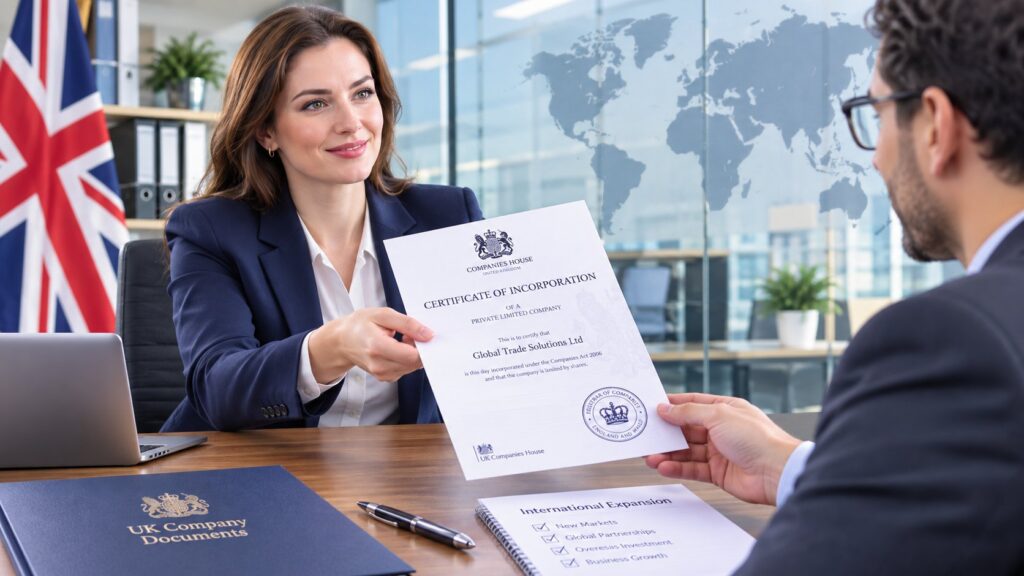
When a UK company expands internationally, opens an overseas bank account, establishes a foreign branch, enters into a business agreement or deals with authorities in another country, it may be asked to provide official company documents. However, a foreign authority may not automatically accept UK-issued business documents without proof that they are genuine.
This is where an apostille can become important. Company directors and business owners are often asked whether documents such as Articles of Association, Certificates of Incorporation, Certificates of Good Standing or other company records can be apostilled. In many cases, the answer is yes, but the correct process depends on the type of document and the requirements of the country where it will be used.
This guide explains how company documents can be apostilled, which business documents commonly require an apostille UK, how the FCDO apostille process works, common mistakes to avoid and when additional embassy legalisation may be required. Company documents apostille UK requirements are often needed when businesses expand internationally.
For a quick overview, watch this video before continuing with the full guide:
What Is an Apostille?
An apostille is an official certificate that authenticates the origin of a public document for international use. It confirms that the signature, stamp or seal on the document has been recognised by the competent authority in the country where the document was issued.
In the UK, apostilles are issued through the Foreign, Commonwealth & Development Office, commonly known as the FCDO.
An apostille is used under the Hague Apostille Convention, which simplifies the process of authenticating documents between participating countries. Instead of requiring several stages of diplomatic or consular legalisation, a document may only need an apostille for use in another participating country.
For businesses, an apostille may be required when official company documents need to be presented to:
- Overseas banks
- Foreign government authorities
- International business partners
- Company registration authorities
- Tax authorities
- Regulatory bodies
- Foreign courts
- Licensing authorities
- Overseas investors
The apostille does not confirm that every statement contained within a company document is accurate. Instead, it authenticates the relevant signature, stamp or official capacity associated with the document.
Can Articles of Association Be Apostilled?
Yes, Articles of Association can often be apostilled, but the correct procedure depends on the version of the document and the requirements of the authority requesting it.
Articles of Association set out important rules governing how a company is run. They may cover matters such as:
- The rights of shareholders
- The responsibilities of directors
- Company decision-making procedures
- Share-related matters
- Voting rights
- Rules concerning company administration
When a UK company is conducting business abroad, a foreign authority may request the company’s Articles of Association as evidence of its legal structure or authority.
Can a Certificate of Incorporation Be Apostilled?
A Certificate of Incorporation is one of the most common company documents used for international business purposes. It confirms that a company has been formally incorporated and provides key information about the company’s legal existence.
A foreign bank, authority or business partner may request an apostilled Certificate of Incorporation when verifying a UK company.
A Certificate of Incorporation may contain information such as:
- The company name
- The company number
- The date of incorporation
- The type of company
- Confirmation of incorporation
Because this document is associated with Companies House records, it is commonly requested during international business transactions and overseas company registration procedures.
However, businesses should ensure that they provide the correct official document or an acceptable certified version. A simple unofficial printout may not always be suitable for apostille purposes.
Other Company Documents That May Require an Apostille
Articles of Association and Certificates of Incorporation are not the only business documents that may require legalisation.
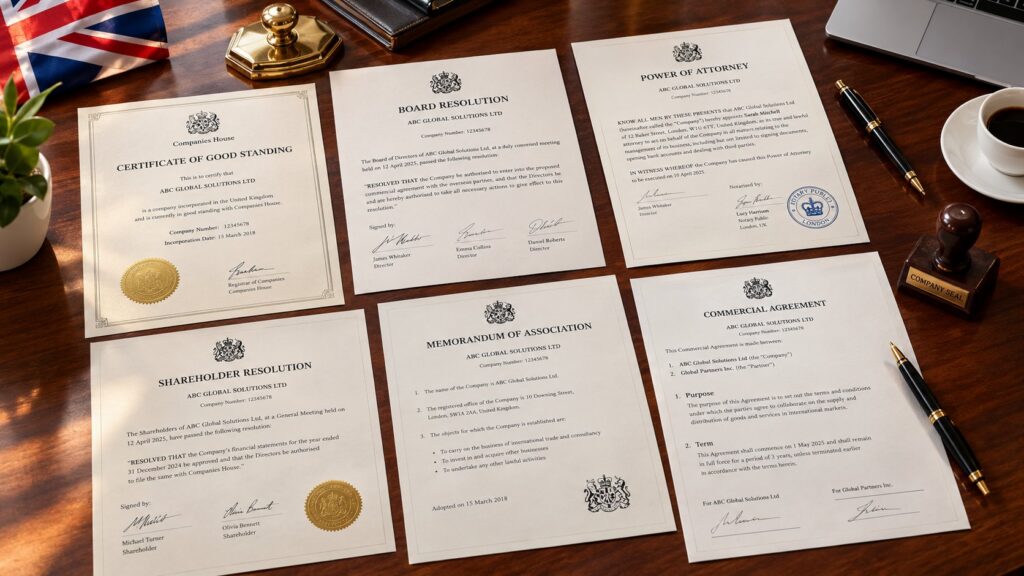
Depending on the purpose of the transaction, the following documents may also need an apostille UK:
Certificate of Good Standing
A Certificate of Good Standing may be requested by overseas authorities to confirm that a company remains properly registered and active.
Board Resolutions
A board resolution may need an apostille when it authorises a company director or representative to take action overseas.
Powers of Attorney
A company may issue a Power of Attorney allowing someone to act on its behalf in another country. This document may require notarisation and an apostille before it can be accepted abroad.
Shareholder Resolutions
Foreign authorities may request shareholder resolutions when confirming ownership decisions or corporate authority.
Memorandum of Association
Depending on the age and structure of the company, a Memorandum of Association may be required alongside other incorporation documents.
Commercial Agreements
Some agreements, contracts or declarations may need to be notarised and apostilled when they are intended for official use abroad.
Company Documents Apostille UK Process (Step-by-Step)
The process of obtaining an apostille for a company document usually begins by identifying the type of document and confirming the requirements of the receiving authority.
Step 1: Check the Requirements of the Destination Country
Before submitting any documents, confirm whether the country where the documents will be used accepts apostilles.
If the destination country is part of the Hague Apostille Convention, an apostille may be sufficient.
However, if the destination country does not accept apostilles, additional embassy or consular legalisation may be required after the document has been legalised.
It is also important to ask the receiving organisation whether it requires:
- An original document
- An official copy
- A certified copy
- A recently issued document
- Notarisation
- An apostille
- Embassy legalisation
- A translation
Checking these requirements in advance can prevent unnecessary delays.
Step 2: Prepare the Correct Company Document
The next step is to obtain the correct version of the company document.
For example, a foreign bank may specifically request an official Certificate of Incorporation rather than an ordinary online copy. Similarly, a company may need a certified copy of its Articles of Association.
Step 3: Notarisation or Certification, Where Required
Some company documents may need to be notarised or certified before an apostille can be issued.
For example, a private business document signed by a company director may need to be signed or certified in front of a UK notary public. The notary’s signature can then be authenticated through the apostille process.
Step 4: Submit the Document for the FCDO Apostille Process
Once the document is correctly prepared, it can proceed for an FCDO apostille.
The FCDO verifies the relevant signature, stamp or seal before issuing the apostille.
The apostille is then attached or associated with the document so that it can be used internationally.
For professional assistance with the process, businesses can use an apostille service UK provider. You can learn more about the process through 2eApostille’s Apostille Service UK page.
Step 5: Complete Additional Legalisation if Necessary
If the destination country requires further authentication, the document may need to go through embassy or consular legalisation after the apostille stage.
This can involve additional procedures, so businesses should allow enough time before any overseas deadline.
Which Company Documents Need Notarisation Before an Apostille?
Not every company document follows exactly the same route.
Generally, documents that already have an official signature or seal may be suitable for apostille without the same preparation required for private documents.
However, documents created privately by a company may need notarisation first.
Examples can include:
- A Power of Attorney signed by a company
- Board resolutions
- Corporate declarations
- Commercial agreements
- Letters of authorisation
- Affidavits or sworn statements
Common Personal Documents That May Also Require an Apostille
Businesses are not the only organisations that need document legalisation. Individuals frequently require an apostille for personal documents when moving, studying, working or getting married abroad.
Common examples include:
- Birth certificates
- Marriage certificates
- Degree certificates
- Academic transcripts
- Police certificates
- DBS checks
- Powers of Attorney
- Court documents
- Wills and probate documents
How Long Does It Take to Apostille Company Documents?
The time required depends on several factors, including:
- The type of document
- Whether notarisation is required
- The condition of the document
- Whether the correct version has been provided
- The FCDO processing stage
- Whether embassy legalisation is needed
- Courier and delivery arrangements
A straightforward document that is ready for apostille may take less time than a document requiring notarisation or additional legalisation.
Businesses with urgent deadlines should not assume that the process can always be completed immediately. The safest approach is to prepare the documents as early as possible and confirm the full legalisation route before starting.
If embassy legalisation is required after the apostille, the overall process may take longer.
Common Mistakes to Avoid When Apostilling Company Documents
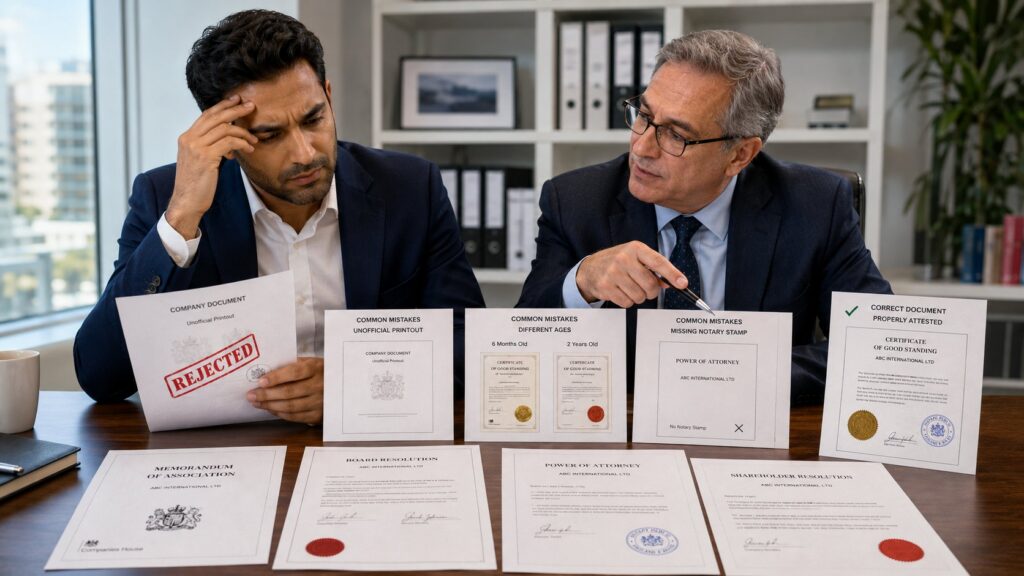
Company document legalisation can be delayed when businesses overlook important requirements.
Using an Unofficial Copy
One common mistake is submitting a simple online printout when the receiving authority requires an official document or certified copy.
Always check what version is required.
Apostilling the Wrong Document
A foreign authority may request a specific document, such as a Certificate of Incorporation or Certificate of Good Standing. Sending a different company document may result in rejection.
Forgetting About Notarisation
Privately signed corporate documents may require notarisation before they can receive an apostille.
Failing to complete this stage can delay the process.
Not Checking Whether the Country Accepts Apostilles
An apostille is not necessarily the final step for every country. Some destinations require further embassy or consular legalisation.
Ignoring Document Age Requirements
Some overseas banks and authorities require recently issued company documents. An older document may be rejected even if it has been correctly apostilled.
Waiting Until the Last Minute
International business transactions often have strict deadlines. Notarisation, apostille and embassy legalisation can take time, so it is best to start early.
Do Company Documents Need to Be Translated?
If the receiving authority uses a language other than English, it may require the company documents to be translated.
The translation requirements can vary. The authority may request:
- A professional translation
- A certified translation
- A notarised translation
- Both the original and translated document
Do not assume that an apostille automatically removes the need for translation.
It is important to check whether the authority requires the translation itself to be certified or legalised.
When Is Additional Embassy Legalisation Required?
Additional embassy legalisation may be required when the destination country does not accept the Hague Apostille Convention or when the relevant authority specifically requires further authentication.
The process may involve:
- Preparing or notarising the company document
- Obtaining an apostille from the FCDO
- Submitting the document to the relevant embassy or consulate
- Completing any further authentication required
Requirements differ between countries, so businesses should confirm the correct route before arranging the legalisation of their documents.
Why Professional Help Can Be Useful for Business Document Legalisation
International document requirements can be confusing, especially when a company needs several documents legalised for different purposes.
A professional apostille service can help identify whether documents may require:
- Notarisation
- Certification
- An FCDO apostille
- Embassy legalisation
- Translation
This can be particularly useful when dealing with urgent international transactions, overseas banking requirements or company registration deadlines.
For more information about apostille service UK options, visit the 2eApostille Apostille Service UK page.
Frequently Asked Questions
Can Articles of Association be apostilled?
Yes, Articles of Association can often be prepared for apostille, depending on the format of the document and the requirements of the destination authority.
Can a Certificate of Incorporation be apostilled?
Yes. A Certificate of Incorporation is commonly used as evidence of a company’s legal existence and may be required for overseas business purposes.
Do company documents need to be notarised before an apostille?
Not always. Official company documents may follow a different process from privately signed documents. Some corporate documents, such as a Power of Attorney or board resolution, may require notarisation first.
How long does a company document apostille take?
The timeline depends on the document, preparation requirements and whether additional embassy legalisation is required. Starting the process early is recommended.
Can I use the same apostilled company document in different countries?
Possibly, provided the receiving countries accept apostilles and the document meets their specific requirements. However, some authorities may require a recently issued document or a new certified copy.
What if the destination country does not accept apostilles?
The document may require additional embassy or consular legalisation after the UK legalisation process. The exact requirements depend on the destination country.

Conclusion
Company documents such as Articles of Association and Certificates of Incorporation can often be apostilled for international use. However, the correct process depends on the type of document, whether it requires notarisation and the legalisation requirements of the destination country.
Before beginning the process, it is important to check exactly what the foreign authority requires. This includes confirming whether an original, official copy or certified copy is needed and whether additional steps such as translation or embassy legalisation are required.
Using the wrong version of a company document or failing to complete the correct preparation can cause unnecessary delays. Businesses should also remember that an FCDO apostille may not be sufficient for countries that require further consular legalisation.
If your company needs help with an apostille UK for Articles of Association, a Certificate of Incorporation or other apostille documents UK, 2eApostille can assist with the process. Visit our Apostille Service UK page to get professional support with your UK document legalisation requirements.