
Does the Apostille Itself Need to Be Translated?
Introduction
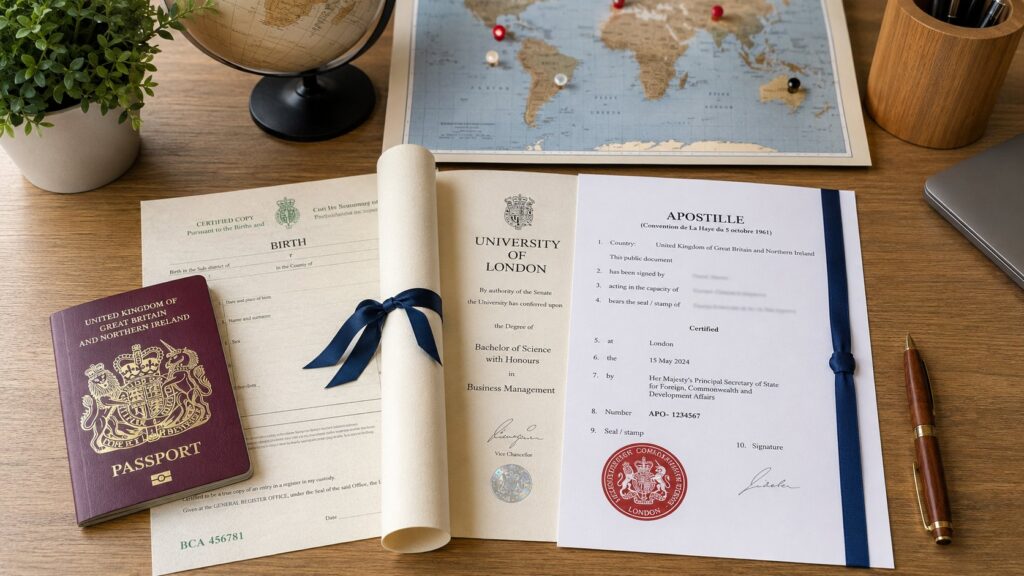
Does the Apostille Itself Need to Be Translated? This is one of the most common questions people ask when preparing UK documents for use abroad.If you are preparing UK documents for use abroad, you may already know that many foreign authorities require an FCDO apostille to verify that your documents are genuine.
The answer depends on the country where you intend to use your documents. While the apostille certificate is issued in a standard international format recognised under the Hague Apostille Convention, some overseas authorities may still request a certified translation of the attached document, the apostille certificate, or both. Understanding these requirements before submitting your paperwork can help you avoid unnecessary delays, additional costs, or rejected applications.
Whether you are relocating overseas, applying for a work visa, enrolling at a university, getting married abroad, or expanding your business internationally, knowing when translations are required is just as important as obtaining the apostille itself.
If you need a reliable apostille service UK, visit our dedicated service page:
Before continuing, watch this short video explaining the apostille and legalisation process.
What Is an Apostille?
An apostille is an official certificate issued by the Foreign, Commonwealth & Development Office (FCDO) that confirms the authenticity of a UK public document or a correctly certified private document.
The apostille verifies:
- The signature on the document.
- The official seal or stamp.
- The authority of the person who signed the document.
It does not certify the content of the document. Instead, it confirms that the document has been issued or certified by an authorised person, allowing it to be recognised in countries that are members of the Hague Apostille Convention.
Many overseas authorities require an FCDO apostille before accepting UK documents for immigration, education, employment, business, legal matters, or marriage abroad.
Does the Apostille Itself Need to Be Translated?
In many cases, no.
One of the advantages of the Hague Apostille Convention is that the apostille certificate follows a standard international format. Although it is issued by the UK, it contains the French title “Apostille (Convention de La Haye du 5 octobre 1961)”, making it easily recognisable to authorities in all Hague Convention countries.
Because of this internationally recognised format, many countries accept the apostille certificate without requiring it to be translated.
However, some authorities may request:
- A certified translation of the original document.
- A certified translation of both the document and the apostille.
- A complete translated document package.
- Additional notarisation or embassy legalisation.
The exact requirement depends on the destination country and the organisation receiving the documents.
Why Might a Translation Still Be Required?
Many clients ask, “Does the Apostille Itself Need to Be Translated?” The answer depends on the requirements of the destination country and the receiving authority.
Although the apostille certificate itself is internationally recognised, the official reviewing your paperwork may need to understand the entire document package.
For example, a foreign authority may request:
- A translated birth certificate.
- A translated marriage certificate.
- A translated degree certificate.
- A translated business document.
In some situations, the apostille attached to the document is translated together with the document to provide a complete and consistent submission.
This is especially common in countries where English is not widely used for official government procedures.
Which Countries May Require Translated Apostilled Documents?
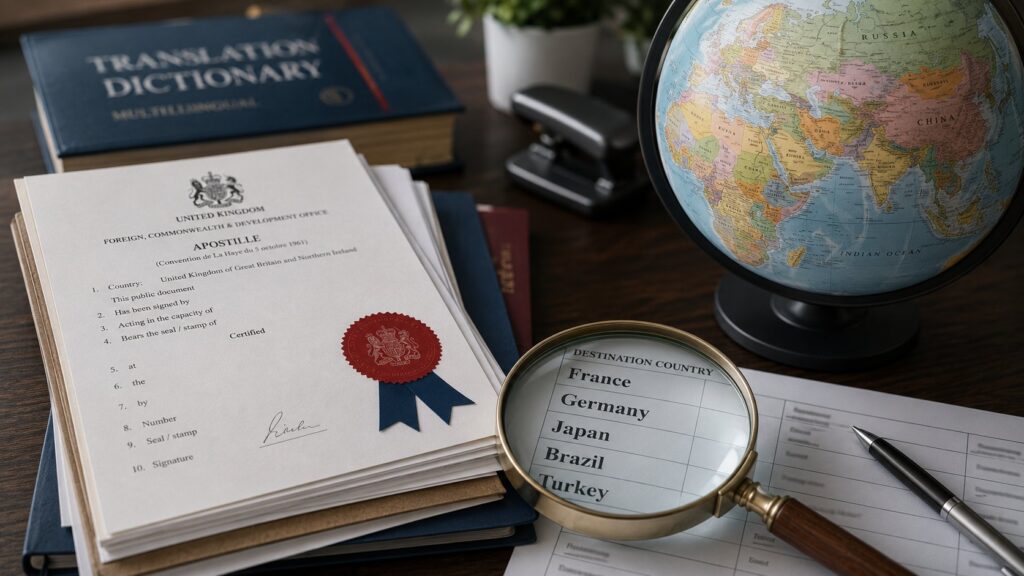
Translation requirements vary from one country to another.
Countries that commonly request certified translations include:
- France
- Germany
- Spain
- Italy
- Portugal
- Poland
- Czech Republic
- Hungary
- Romania
- Turkey
- Japan
- South Korea
- Brazil
The receiving authority—not the apostille itself—usually determines whether a translation is required.
For this reason, it is always advisable to confirm the latest requirements before submitting your paperwork.
Which Documents Commonly Need Translation?
Many apostille documents UK may require certified translation before they are accepted overseas.
Personal Documents
Examples include:
- Birth certificates
- Marriage certificates
- Death certificates
- Adoption certificates
- Civil partnership certificates
- Deed Poll name change certificates
These are commonly required for immigration, residency applications, overseas marriages, and family registration.
Educational Documents
Students and professionals frequently require translated educational documents.
Common examples include:
- Degree certificates
- Academic transcripts
- Diplomas
- GCSE certificates
- A-Level certificates
- Professional qualifications
Many overseas universities and employers request certified translations alongside the apostille.
Business Documents That May Need Translation
Companies expanding into international markets often need both document legalisation UK and certified translations before their documents are accepted by foreign authorities.
Common business documents include:
- Certificate of Incorporation
- Articles of Association
- Certificate of Good Standing
- Company resolutions
- Commercial contracts
- Shareholder agreements
- Powers of Attorney
- Board meeting minutes
Depending on the destination country, these documents may need to be translated by a qualified translator before or after receiving an FCDO apostille.
Legal Documents
Legal documents frequently require certified translation to ensure overseas authorities can accurately understand their contents.
Examples include:
- Powers of Attorney
- Court orders
- Affidavits
- Statutory declarations
- Divorce certificates
- Probate documents
- Wills
Some legal documents may also require notarisation before they are eligible for an apostille.
Medical Documents
Medical documents are another category that often requires certified translation.
Examples include:
- Medical reports
- Doctor’s letters
- Vaccination certificates
- Health certificates
- Disability assessments
- Medical fitness certificates
These documents are commonly submitted for immigration, overseas employment, residency applications, and international healthcare purposes.
How Does the Apostille and Translation Process Work?
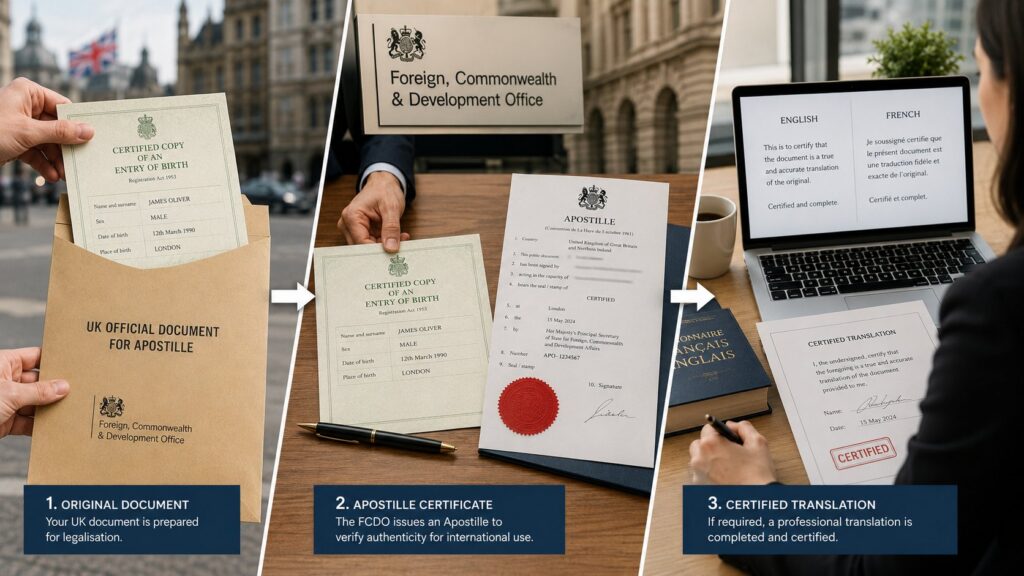
If your destination country requires translated documents, following the correct legalisation process helps ensure they are accepted without delays.
Step 1: Prepare Your Original Documents
Begin by obtaining the correct original document or a properly certified copy.
Common apostille documents UK include:
- Birth certificates
- Marriage certificates
- Degree certificates
- Business documents
- Employment letters
- Powers of Attorney
Some private documents require certification by a solicitor or notary public before an apostille can be issued.
Step 2: Obtain the FCDO Apostille
Your documents are submitted to the Foreign, Commonwealth & Development Office (FCDO).
The FCDO confirms:
- The official signature.
- The government seal or stamp.
- The authority of the person who signed the document.
Once verified, the official apostille certificate is attached.
Step 3: Arrange a Certified Translation
If the receiving authority requires translated documents, a qualified translator prepares an accurate translation.
Depending on the country’s requirements, the translator may translate:
- The original document only.
- The original document together with the attached apostille.
- The complete document package.
The translator usually provides a signed statement confirming that the translation is complete and accurate.
Step 4: Submit Your Documents
Once your documents have been apostilled and translated, they can be submitted to the overseas authority.
Some countries may also require:
- Embassy legalisation.
- Certified copies.
- Additional supporting documents.
- Certified translations of supplementary paperwork.
Checking the requirements beforehand helps prevent delays.
How Long Does Translation and Apostille Take?
Processing times depend on several factors, including:
- The type of document.
- Whether solicitor certification is required.
- The language of the translation.
- FCDO processing times.
- Courier delivery.
- The destination country’s requirements.
If your documents are needed urgently, many providers offer priority apostille service UK options to help meet tight deadlines.
Common Mistakes to Avoid
Many applications are delayed because applicants overlook important translation requirements.
Assuming the Apostille Never Needs Translation
Although the apostille follows an internationally recognised format, some overseas authorities may still request that it be translated together with the document.
Translating Documents Yourself
Most official authorities do not accept self-translated legal documents. Always use a qualified or certified translator.
Using an Unqualified Translator
Poor-quality translations can result in rejected applications and additional costs.
Choose a professional translator who has experience with official legal and government documents.
Forgetting Country-Specific Requirements
Every country has its own document requirements.
Some require:
- Certified translations.
- Notarised translations.
- Embassy legalisation.
- Recently issued certificates.
Always confirm these requirements before submitting your documents.
Leaving the Process Too Late
Translation, certification, and legalisation all require time.
Starting the process early reduces stress and avoids missing important deadlines.
Why Choose a Professional Apostille Service UK?
Using a trusted apostille service UK helps ensure your documents are correctly prepared for international use.
Professional providers can:
- Review your documents before submission.
- Confirm whether translations are required.
- Arrange certified translations.
- Organise solicitor or notary certification.
- Obtain your FCDO apostille.
- Advise whether the apostille itself should be translated.
- Arrange embassy legalisation where necessary.
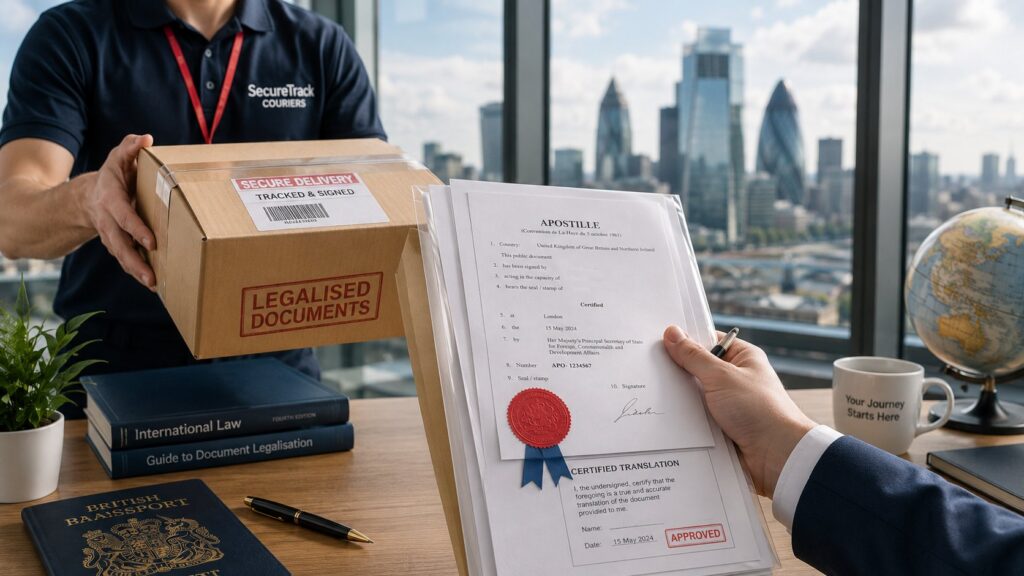
- Return your documents securely using tracked delivery.
Working with experienced specialists helps minimise delays and gives you confidence that your documents will meet the requirements of the receiving country.
Frequently Asked Questions
1. Does the apostille itself need to be translated?
Usually, no. The FCDO apostille follows a standard international format recognised under the Hague Apostille Convention. However, some foreign authorities may request a certified translation of the apostille along with the attached document.
2. Who decides whether the apostille or document needs translation?
The receiving authority in the destination country determines whether a translation is required. Always check their specific requirements before submitting your documents.
3. Which documents commonly require certified translation?
Common apostille documents UK include birth certificates, marriage certificates, degree certificates, academic transcripts, business documents, medical reports, and Powers of Attorney.
4. Can I translate an apostilled document myself?
In most cases, no. Official authorities generally require translations to be completed by a qualified or certified translator to ensure accuracy and acceptance.
5. Can an apostille service arrange certified translations?
Yes. Many professional apostille service UK providers can arrange certified translations, obtain the FCDO apostille, and advise whether any additional legalisation is required.
6. How can I avoid delays when legalising documents for overseas use?
Prepare your documents early, confirm the destination country’s requirements, use certified translators where necessary, and seek advice from a trusted document legalisation UK provider.
Conclusion
Does the Apostille Itself Need to Be Translated? In most cases, the answer is no. However, some overseas authorities require certified translations of the document, the apostille, or both.
Understanding whether the apostille itself needs to be translated is an important part of preparing UK documents for international use. In many cases, the answer is no, because the FCDO apostille is issued in a standard format recognised by countries that are members of the Hague Apostille Convention.
Because every country has its own procedures, obtaining professional guidance can save valuable time and help you avoid rejected applications or unnecessary expenses. An experienced apostille service UK can review your documents, confirm whether certified translations are needed, arrange solicitor or notary certification where required, obtain your FCDO apostille, and advise if any additional embassy legalisation is necessary.
To learn more or begin your application today, visit our Apostille Service UK page:
Whether you need to legalise a birth certificate, marriage certificate, degree certificate, business document, Power of Attorney, medical report, or any other official paperwork, 2eApostille offers expert support throughout the entire process. From document review and certified translations to obtaining your FCDO apostille and arranging any additional legalisation, we are committed to making international document authentication straightforward, efficient, and stress-free.